


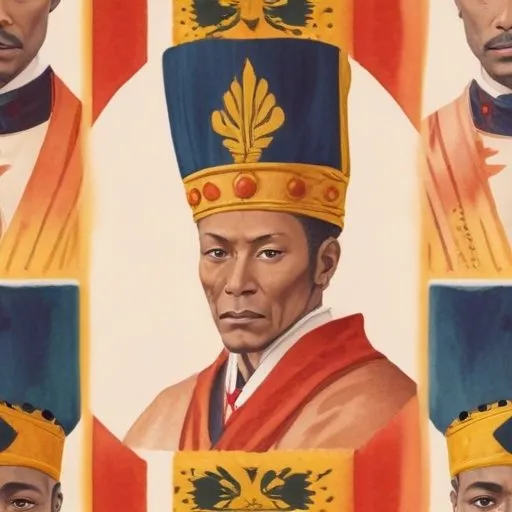
Reigned from 1412 to 1428, this emperor restored imperial authority and promoted cultural development, earning a reputation as a patron of the arts. He's also known for his efforts to reform the government and economy.
Emperor Shk, also known as Shktenn, was the 101st emperor of Japan, reigning from 1412 to 1428, according to the traditional order of succession. He is remembered for his significant contributions to Japanese history, politics, and culture during the Muromachi period.
Emperor Shk was born on May 12, 1401, as Mihito, the eldest son of Emperor GoKomatsu. His mother was Hinonishi Motoko, daughter of Hino Sukekuni. His personal name was later changed to Shk, combining one kanji from the names of Empress Shtoku and Emperor Knin.
Shk became emperor upon the abdication of his father, Emperor GoKomatsu, in 1412, at the tender age of 12. Although he was the formal head of the Daijo-ten, his father GoKomatsuin held direction of the court, and the Shogun Ashikaga Yoshimochi was in charge of general superintendence of affairs.
During his reign, Shk was connected to Ashikaga Yoshimitsu and the Hino clan through his mother's side. His actual coronation date was two years later, in 1414.
As the emperor, Shk was deeply committed to maintaining the traditional order of succession and upholding the imperial family's prestige. He believed in the importance of maintaining harmony between the imperial court and the shogunate.
Emperor Shk's reign marked a significant period in Japanese history, shaping the country's political and cultural landscape. His legacy continues to influence modern Japanese society, with his name and reign serving as a testament to the enduring traditions of the imperial family.
Shk's major achievement was maintaining stability and harmony between the imperial court and the shogunate during his reign. He also played a crucial role in promoting cultural and artistic developments during the Muromachi period.
Emperor Shk's reign was marked by significant historical events, including the reign of the Muromachi shoguns and the rise of the Ashikaga clan. His legacy continues to be felt in modern Japan, with his name and reign serving as a symbol of the country's rich cultural heritage.
In conclusion, Emperor Shk's life and reign were marked by significant cultural, political, and historical achievements. His legacy continues to shape modern Japanese society, making him an important figure in Japanese history.
Born in 1800
The 48th emperor of Japan, who reigned from 1817 to 1846 and is remembered for his efforts to reform the Tokugawa shogunate and improve relations with Western nations.
Born in 1771
The 119th emperor of Japan, who reigned from 1780 to 1817, is known for his efforts to reform the imperial system and restore the emperor's authority, as well as his cultural achievements, including poetry and calligraphy.
Born in 1852
Modernized Japan's government and society, transforming it from a feudal state to a modern, industrialized nation. He oversaw rapid modernization and westernization.
