


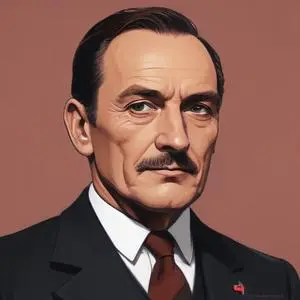
A British politician who served as Secretary of State for Health, infamous for his controversial "Rivers of Blood" speech on immigration, sparking national debate and outrage. He was a polarizing figure in British politics.
Enoch Powell, a British politician, statesman, and classical scholar, is best known for his infamous "Rivers of Blood" speech, which ignited a national debate on immigration and race relations in the UK. This provocative speech, delivered in 1968, cemented Powell's reputation as a provocative and divisive figure in British politics.
John Enoch Powell was born on June 16, 1912, in Stechford, Warwickshire, to Albert Enoch Powell, a primary school headmaster, and Ellen Mary Breese. Powell's early years were marked by a passion for classical languages and literature, which would later shape his academic and professional pursuits. He attended King Edward's School in Birmingham and then went on to study classics at Trinity College, Cambridge, where he earned a double first-class honors degree.
Powell's academic prowess earned him a scholarship to study at Trinity College, Cambridge, where he became a fellow in 1934. He taught classics at Cambridge and later at the University of Sydney, Australia. During World War II, Powell served in the British Army, rising to the rank of brigadier and working in staff and intelligence positions. His wartime experiences deeply influenced his political views and shaped his later critique of British politics.
Powell began his political career as a member of the Conservative Party, serving as a Member of Parliament (MP) for Wolverhampton South West from 1950 to 1974. He held various positions, including Minister of Health (1960-1963) and Shadow Defence Secretary (1965-1968). Powell's political views were deeply influenced by his classical education and his wartime experiences, which led him to advocate for a strong national identity, limited immigration, and a restrictive approach to government spending.
In 1968, Powell delivered his now-infamous "Rivers of Blood" speech, which criticized the UK's immigration policies and argued that unchecked immigration would lead to racial unrest and social upheaval. The speech sparked widespread controversy, and Powell was promptly dismissed from his position as Shadow Defence Secretary by Conservative Party leader Edward Heath. Despite the backlash, Powell's speech resonated with a significant portion of the British public, with polls suggesting that 67-82% of the population agreed with his views.
In 1974, Powell switched parties and joined the Ulster Unionist Party (UUP), representing the Northern Irish constituency of South Down from 1974 to 1987. He continued to advocate for his political views, including his opposition to the Anglo-Irish Agreement, which aimed to establish a power-sharing government in Northern Ireland. Powell died on February 8, 1998, leaving behind a mixed legacy as a politician, statesman, and classical scholar.
Powell's views on immigration, race relations, and national identity continue to spark debate and controversy. Critics have accused him of racism, xenophobia, and intolerance, while supporters argue that his warnings about the dangers of unchecked immigration were prescient and courageous. Powell's legacy remains complex and multifaceted, reflecting both the provocative and the profound aspects of his thought and actions.
Enoch Powell's life and career reflect the complexities and contradictions of post-war Britain. His critique of immigration and national identity resonated with a significant portion of the British public, even as his views were criticized by many as xenophobic and intolerant. Powell's legacy serves as a microcosm of the ongoing debates about national identity, immigration, and race relations that continue to shape British politics and society today.
Born in 1894
A British politician who served as Prime Minister from 1957 to 1963, known for leading the country through a period of economic prosperity and decolonization.
Born in 1903
A British aristocrat who served as Prime Minister from 1963 to 1964, known for his brief tenure and aristocratic background.
Born in 1916
The Prime Minister who led the UK into the European Economic Community (EEC) and navigated the country through a period of economic and industrial turmoil. He's also known for his diplomatic efforts, particularly in regards to the Cold War.
Born in 1925
The first female Prime Minister of the United Kingdom, serving from 1979 to 1990, known for her conservative policies and leadership during the Falklands War.
Born in 1871
Prolific writer of historical novels and adventure stories, also a talented landscape painter.
