


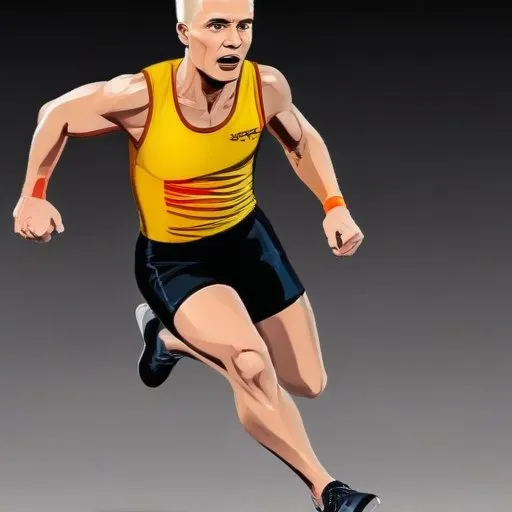
A German sprinter who won several national championships and set multiple records in the 100m and 200m events in the 1950s and 1960s.
Erich Borchmeyer, a German athlete, left an indelible mark on the world of track and field, particularly in the 100 meters sprint. With a storied career that spanned over two decades, Borchmeyer's impressive feats on the track earned him a silver and bronze medal at the Olympic Games.
Born on January 23, 1905, in Münster, Germany, Borchmeyer's athletic prowess became apparent at a young age. His natural speed and agility led him to focus on the 100 meters sprint, an event that would become synonymous with his name.
Borchmeyer's Olympic debut came in 1932 at the Los Angeles Summer Olympics, where he was part of the German 4x100 meters relay team that clinched the silver medal. Alongside teammates Helmut Körniig, Friedrich Hendrix, and Arthur Jonath, they clocked an impressive 40.9 seconds, narrowly missing the gold.
Four years later, at the 1936 Berlin Summer Olympics, Borchmeyer returned as the sole member of the 1932 team, this time joining forces with Wilhelm Leichum, Erwin Gillmeister, and Gerd Hornberger to secure the bronze medal in the same event.
Borchmeyer's impressive athletic career extended beyond the Olympic Games. He held multiple German championships in the 100 meters and 4x100 meters relay, cementing his status as one of Germany's top sprinters of the 1930s.
In his later years, Borchmeyer struggled with personal demons, and on August 17, 2000, at the age of 95, he tragically took his own life in a retirement home in Bielefeld, Germany.
Erich Borchmeyer's remarkable athletic achievements, combined with his perseverance and dedication, have inspired generations of athletes. His legacy serves as a reminder of the importance of mental health awareness and support, particularly for individuals who have achieved greatness.
In the realm of German athletics, Borchmeyer's name is etched alongside the greatest, a testament to the impact he had on the sport. As we remember this remarkable athlete, we honor not only his impressive feats on the track but also the lessons his life story imparts.
Born in 1913
A legendary athlete who shattered records and racial barriers at the 1936 Berlin Olympics, winning four gold medals in the 100m, 200m, 4x100m relay, and long jump events.
65 Years Old
A dominant force in track and field, winning 9 Olympic gold medals and 10 World Championship medals, setting multiple world records in the 100m and long jump events.
39 Years Old
The world's fastest man, holding the 100m and 200m sprint records, dominating the track with unparalleled speed and charisma.
43 Years Old
A world-class sprinter who holds the record for the most sub-10 second 100m runs, dominating the track with his incredible speed and power.
66 Years Old
A renowned Olympic gold medalist and world champion sprinter, known for his exceptional speed and dominance in the 100m dash.
58 Years Old
A Namibian sprinter who won four Olympic silver medals and holds the world indoor record in the 200 meters, dominating the sport in the 1990s.
65 Years Old
A renowned middle-distance runner and coach, known for his impressive athletic career and subsequent coaching success, particularly in the 1980s.
69 Years Old
A renowned Olympic gold medalist and former world record holder in the 800 meters, known for his impressive athletic career and later becoming a prominent politician.
