


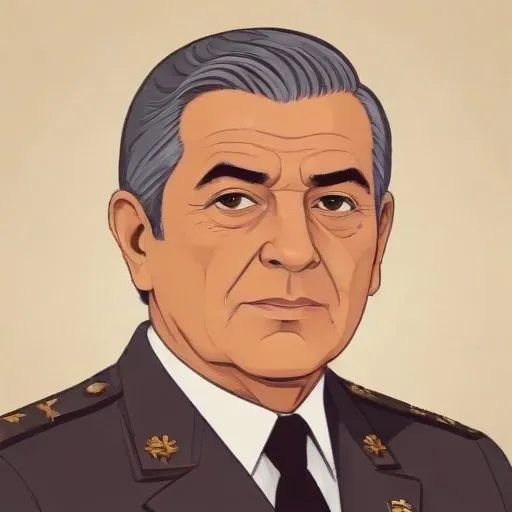
Brazil's 29th President, a military leader who ruled with an iron fist, implementing economic reforms and gradually democratizing the country. He's remembered for his authoritarian yet modernizing governance.
Ernesto Geisel, a pivotal figure in Brazilian history, served as the country's President from 1974 to 1979, leaving an indelible mark on the nation's politics and society. During his tenure, he navigated the complexities of the Brazilian military dictatorship, implementing policies that had far-reaching consequences for the country's economy, politics, and people.
Born on August 3, 1907, in Bento Gonçalves, Rio Grande do Sul, Geisel's life was shaped by his German and Brazilian heritage. His father, Guilherme Augusto Geisel, a German immigrant, instilled in him the importance of rigor and discipline, while his mother, Lydia Beckmann, provided a nurturing environment that allowed him to explore his creativity. Growing up in a small town with a predominantly Italian population, Geisel developed a unique perspective on cultural diversity, which would later influence his political approach.
Geisel's military career spanned over three decades, during which he rose through the ranks to become a respected and influential figure. He was part of the Brazilian Expeditionary Force that fought in World War II, an experience that left a lasting impact on his views on politics and governance. His military background gave him the discipline and strategic thinking that would serve him well in his future roles.
In 1974, Geisel became the President of Brazil, inheriting a nation grappling with economic stagnation, political unrest, and social inequality. He implemented policies aimed at stimulating economic growth, increasing foreign investment, and mitigating the country's dependence on imported oil. Despite facing opposition from various quarters, Geisel remained committed to his vision, earning him both admiration and criticism.
Geisel's presidency had a profound impact on modern Brazilian society. He introduced policies aimed at promoting national development, such as the creation of the Brazilian Development Bank (BNDES) and the establishment of the National Agency for Petroleum, Natural Gas and Biofuels (ANP). While his tenure was marked by controversy, Geisel's vision for Brazil's future continues to shape the country's economic and political landscape.
Ernesto Geisel's legacy is complex and multifaceted. While criticized for his role in the military dictatorship, he is also credited with implementing policies that laid the foundation for Brazil's economic growth in the decades that followed. As a president, he navigated the intricate web of political alliances, ideological differences, and social tensions, leaving behind a legacy that continues to influence Brazilian politics and society.
In conclusion, Ernesto Geisel's life and presidency serve as a testament to the power of vision, leadership, and resilience. Love him or criticize him, Geisel's impact on Brazilian history is undeniable, and his legacy continues to shape the nation's future.
Born in 1918
The 30th President of Brazil, a military leader who ruled from 1979 to 1985, is known for his role in transitioning the country from a military dictatorship to democracy. He implemented amnesty for political prisoners and allowed exiles to return.
Born in 1910
A Brazilian lawyer and politician who served as Prime Minister of Brazil, known for being the first civilian to assume the office after a long period of military rule. He's also famous for dying before taking office, sparking a national crisis.
96 Years Old
A Brazilian lawyer and politician who served as the 31st President of Brazil, known for his role in the country's transition from military to civilian rule. He's also remembered for his controversial presidency marked by economic crisis and corruption allegations.
96 Years Old
Brazil's 33rd President, a skilled engineer and politician, led the country during a period of economic crisis and implemented significant reforms. He's most known for stabilizing the economy and introducing the Real Plan.
