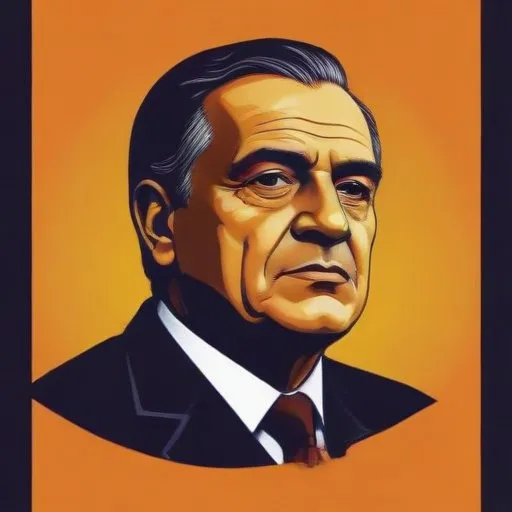
Joo Figueiredo: The Military Leader Who Shaped Brazil's History
The President of Transition
Joo Figueiredo, a Brazilian military leader and politician, is best known for serving as the 30th President of Brazil from 1979 to 1985, marking the last of the military regime that ruled the country following the 1964 Brazilian coup d'état. His presidency was a crucial transition period, as he continued the process of redemocratization initiated by his predecessor,
Ernesto Geisel.
Military Background and Early Life
Born on January 15, 1918, Figueiredo hailed from a family with a rich military tradition. His father, General Euclides Figueiredo, was exiled for attempting to overthrow the Estado Novo regime of Getulio Vargas in 1938. Two of his brothers also became generals. Figueiredo's family roots in Brazil dated back to the 1650s, with ancestors from Barcelos in Northern Portugal who owned sugar plantations and slaves.
Figueiredo studied at military schools in Porto Alegre and Realengo, eventually rising through the ranks. He was promoted to captain in 1944 and major in 1952. His military career took him to Paraguay, where he served as the Brazilian military attaché from 1955 to 1957.
Rise to Power and Presidency
Figueiredo's rise to power began when he worked for the secret service of the Army General Staff from 1959 to 1960. He was later transferred to the National Security Council in 1961. While teaching at the Army General Staff Command College from 1961 to 1964, Figueiredo became a key figure in the military regime.
In 1979, Figueiredo was appointed president by his predecessor, Ernesto Geisel, marking the beginning of his six-year term. During his presidency, Figueiredo continued the process of redemocratization, sanctioning a law that decreed amnesty for all political crimes committed during the military regime.
Challenges and Controversies
Figueiredo's presidency was not without its challenges. The country faced a severe economic crisis, and growing dissatisfaction with the military rule culminated in the Diretas J protests of 1984. These protests demanded direct elections for the presidency, which had not occurred in 24 years. Figueiredo opposed this, and in 1984, Congress rejected the immediate return of direct elections, instead opting for an indirect election by Congress.
This decision was met with widespread discontent, and the opposition candidate Tancredo Neves eventually emerged victorious in the indirect election. Figueiredo's term ended in 1985, marking the end of the military regime and the beginning of Brazil's transition to democracy.
Legacy and Impact
Joo Figueiredo's legacy is complex and multifaceted. While he played a crucial role in Brazil's transition to democracy, his presidency was also marred by economic turmoil and authoritarian tendencies. Nevertheless, his decision to continue the process of redemocratization initiated by Geisel paved the way for Brazil's eventual return to democratic rule.
Today, Figueiredo is remembered as a transitional figure, whose presidency marked the end of Brazil's military regime and the beginning of a new era of democracy. His legacy serves as a reminder of the importance of democratic institutions and the need for accountability in governance.
FAQ
What was João Figueiredos role in Brazilian politics?
João Figueiredo was the 30th President of Brazil, serving from 1979 to 1985, and played a crucial role in the countrys transition from military rule to democracy. He is known for his efforts to reform the economy and promote human rights.
How did João Figueiredos presidency impact Brazils economy?
During his presidency, João Figueiredo implemented several economic reforms, including the creation of a new currency, the cruzado, and the liberalization of trade policies. These measures helped to reduce inflation and stimulate economic growth.
What were João Figueiredos views on human rights?
João Figueiredo was a strong advocate for human rights, and his government made significant progress in this area. He established the Ministry of Justice and Human Rights, and his administration investigated and prosecuted human rights abuses committed during the previous military regime.
How did João Figueiredos presidency relate to the Brazilian military?
As a former general, João Figueiredo had strong ties to the Brazilian military. However, during his presidency, he worked to reduce the militarys influence in politics and promote civilian rule.
What was João Figueiredos legacy in Brazilian politics?
João Figueiredos presidency marked a significant transition in Brazilian politics, from military rule to democracy. He is remembered for his efforts to promote human rights, reform the economy, and consolidate democratic institutions.