


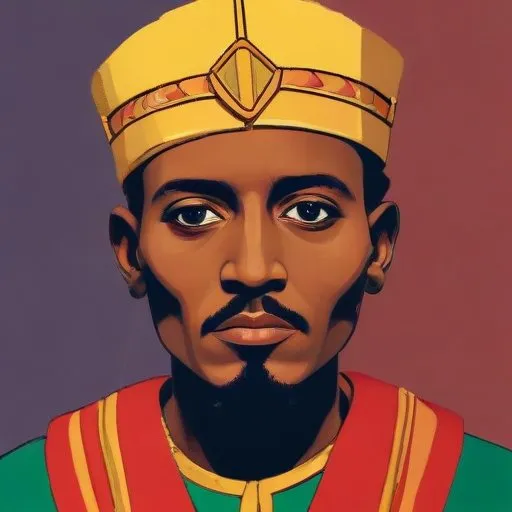
The 15th-century Ethiopian emperor who oversaw a golden age of cultural and economic prosperity, commissioning grand architectural projects and promoting Christian Orthodox traditions.
Eskender, also known as Kwestantinos II Geez or Constantine, was the Emperor of Ethiopia from 1471 to 1494, making him a prominent figure in the Solomonic dynasty. He is best known for his military conquests, particularly against the Adal Sultanate, and his diplomatic efforts, including hosting the Portuguese envoy Pedro de Covilham.
Eskender was born on July 15, 1471, to Emperor Baeda Maryam I and Queen Romna. Due to his young age, a council was formed to guide his rule, comprising his mother, Tasfa Giyorgis, the abbot of the monastery of Lake Hayq, and the Bitwoded Amda Mikael. However, Queen Romna soon withdrew from this arrangement, leaving the council in the hands of the experienced Bitwoded.
During his reign, Eskender faced challenges from the nobility and the ecclesiastical elite, who vied for power and influence. Despite these obstacles, he demonstrated his military prowess, leading several battles against the Adal Sultanate.
Eskender's most significant military achievement was the sacking of Dakkar, the capital of the Adal Sultanate, in 1478. He destroyed houses and places of worship, leaving a lasting impact on the region. However, on his return journey, his army was overtaken by the Adal forces, resulting in significant losses and prisoners taken. Eskender himself escaped capture, reportedly with the assistance of angels, and later built a church named Debere Meshwae (Place of Sacrifice) in commemoration of this event.
Eskender's reign was also marked by diplomatic efforts, including the visit of the Portuguese envoy Pedro de Covilham. Initially, Covilham was received as a guest, but he was eventually forced to stay as an advisor to the emperor.
Eskender's reign came to an abrupt end with his death at the age of 22, which led to a civil war between his son, Amda Seyon II, and his half-brother, Naod. Despite the turmoil that followed, Eskender's military accomplishments and diplomatic efforts had a lasting impact on the kingdom of Ethiopia.
Through his military conquests and diplomatic efforts, Eskender left an indelible mark on Ethiopian history, securing his place as a prominent figure in the Solomonic dynasty.
Born in 1892
The last emperor of Ethiopia, who led the country through a period of modernization and was a symbol of African independence, and is also revered as a deity by the Rastafari movement.
