


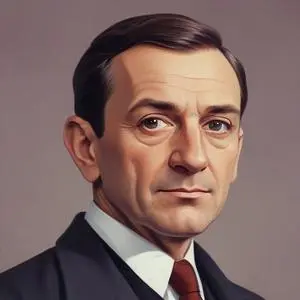
Developed the first commercially viable catalytic cracking process, revolutionizing the petroleum industry by allowing for mass production of gasoline and other petroleum products.
Eugene Houdry is renowned for revolutionizing the petroleum industry with his innovative catalytic cracking process, a breakthrough that transformed the way crude oil is refined and utilized. This French-born mechanical engineer's groundbreaking work earned him numerous accolades, including the prestigious Perkin Medal.
Born on April 18, 1892, in Domont, France, Eugene Houdry was the son of Jules Houdry, a successful structural steel manufacturer. Houdry's academic prowess was evident from an early age, and he went on to study mechanical engineering at the renowned École Nationale Supérieure d'Arts et Métiers in Paris.
Graduating at the top of his class in 1911, Houdry was awarded a gold medal by the French government for his outstanding academic achievements. An accomplished athlete, he also captained his school's soccer team, leading them to the national championship of France in 1910.
During World War I, Houdry served in the French army, initially as a lieutenant in the field artillery. He later transferred to the tank corps, participating in the first French battle to use tanks, part of the Nivelle Offensive in 1917. Houdry's bravery and selflessness during the Second Battle of the Aisne earned him the Croix de Guerre and the distinction of being made a Chevalier of the Legion of Honor.
After the war, Houdry's fascination with the petroleum industry led him to develop the catalytic cracking process, which enabled the efficient conversion of heavy crude oil into high-octane gasoline and other valuable petroleum products. This innovation revolutionized the industry, making it possible to produce high-quality fuels on a large scale.
Houdry's pioneering work was recognized with numerous awards and honors, including the Perkin Medal, the most prestigious award in the field of applied chemistry. He was also awarded the French Legion of Honor, the nation's highest order of merit.
In his personal life, Houdry was an avid road racing enthusiast and enjoyed driving his Bugatti racing car. Through his family's steel company, he developed a passion for mechanical engineering that would stay with him throughout his life.
Eugene Houdry's catalytic cracking process has had a profound impact on the petroleum industry, enabling the large-scale production of high-quality fuels that power modern transportation. His legacy continues to inspire future generations of engineers and scientists, cementing his place as one of the most influential mechanical engineers of the 20th century.
Born in 1834
Co-founder of the first high-speed internal combustion engine and the company that bears his name, revolutionizing the automotive industry with innovative designs and manufacturing techniques.
Born in 1846
Founded the luxury car brand Maybach, known for designing and building high-performance engines and exclusive vehicles. His innovative designs and precision engineering set a new standard for the automotive industry.
Born in 1856
A pioneering engineer who harnessed the power of alternating current (AC) to transform the world's electrical systems, and is credited with developing groundbreaking technologies like radio communication and X-ray imaging.
Born in 1863
Founded the pioneering automobile manufacturing company that revolutionized the industry with the assembly line production method, making cars more affordable and accessible to the masses.
Born in 1858
A German engineer who invented the Diesel engine, a revolutionary internal combustion engine that transformed the industrial landscape. This innovation enabled more efficient and powerful machines, shaping modern transportation and industry.
Born in 1875
Designed iconic sports cars, including the Volkswagen Beetle, and founded a legendary company that bears his name, synonymous with speed and luxury.
Born in 1881
Founded the luxury car brand Bugatti, creating iconic, high-performance vehicles that epitomize style and sophistication. His designs continue to inspire and influence the automotive industry.
Born in 1878
French engineer and businessman who revolutionized the automotive industry by mass-producing innovative, affordable cars, making them accessible to the average consumer.
