


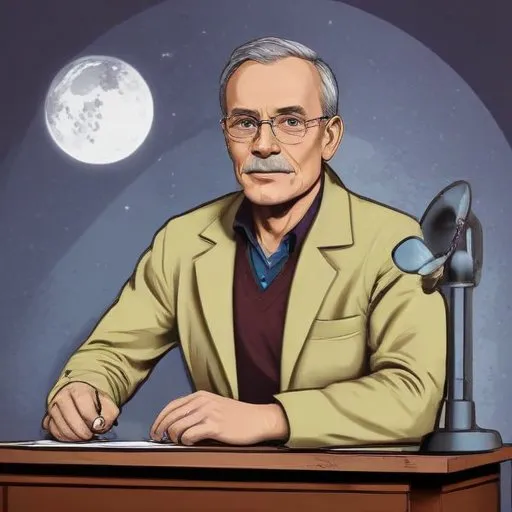
A pioneering geologist and astronomer who discovered numerous asteroids and comets, and was the first person to be buried on the Moon.
Imagine discovering a comet that would later collide with Jupiter, creating a spectacle that would captivate the world. This extraordinary feat belongs to Eugene Merle Shoemaker, an American geologist who codiscovered Comet Shoemaker-Levy 9, an event that would make history in the scientific community.
Shoemaker was born on April 28, 1928, in Los Angeles, California, to Muriel May and George Estel Shoemaker. His early years were marked by frequent moves between Los Angeles, New York City, Buffalo, and Wyoming, as his father worked on various jobs. However, it was during his childhood summers spent in Wyoming that Shoemaker's fascination with rocks and geology began to take shape.
Shoemaker's passion for geology was ignited by the science education courses offered by the Buffalo Museum of Education. He began collecting mineral samples and even took high school-level evening courses while still in elementary school. This early start laid the foundation for his future accomplishments in the field of geology.
Shoemaker's work took him to the United States Geological Survey (USGS), where he became the first director of the Astrogeology Research Program. His research focused on terrestrial craters, and he, along with Edward Chao, provided conclusive evidence that Barringer Meteor Crater in Arizona was an impact crater.
However, it was his collaboration with his wife, Carolyn S. Shoemaker, and David H. Levy that led to the discovery of Comet Shoemaker-Levy 9. The comet's impact with Jupiter in July 1994 was a groundbreaking event, captivating the world and shedding new light on the mysteries of our solar system.
Tragically, Shoemaker's life was cut short in a car accident on July 18, 1997, while he was visiting an impact crater site in Australia. However, his legacy lived on when a portion of his ashes were carried to the Moon aboard the Lunar Prospector mission, a fitting tribute to a man who had spent his life exploring the mysteries of the cosmos.
Eugene Merle Shoemaker's contributions to the field of geology and astrogeology have left an indelible mark on our understanding of the universe. His groundbreaking research and discoveries continue to inspire future generations of scientists and astronomers, ensuring his legacy will endure for generations to come.
"I don't think I've ever been so excited about anything in my life. It's the most fantastic thing I've ever seen." - Eugene Merle Shoemaker, on the discovery of Comet Shoemaker-Levy 9
Shoemaker's words encapsulate the sense of wonder and awe that drives human exploration and discovery, a testament to the enduring power of his legacy.
96 Years Old
First person to walk on the Moon during the Apollo 11 mission, marking a historic milestone in space exploration.
96 Years Old
Second man to walk on the Moon during the Apollo 11 mission, a pioneering astronaut and advocate for space exploration.
96 Years Old
Led the third manned mission to land on the Moon, Apollo 12, and became the third person to walk on its surface. Known for his bold and fearless approach to space exploration.
94 Years Old
One of the 12 humans to walk on the Moon during NASA's Apollo program, known for his moonwalk during Apollo 12 and later becoming a painter, capturing the beauty of space through art.
98 Years Old
Commander of the Apollo 13 mission, known for his heroic efforts in saving his crew after an explosion occurred on board. He's an iconic figure in space exploration history.
95 Years Old
Astronaut and pilot who flew on Apollo 13, famously uttering "Houston, we've had a problem" during the mission's critical malfunction. He played a crucial role in saving the crew from disaster.
93 Years Old
Astronaut and engineer who flew on the Apollo 13 mission, known for his bravery and ingenuity during the mission's critical failure. He also flew on the Enterprise during the Approach and Landing Tests.
94 Years Old
Commander of Apollo 15, a pioneering astronaut who walked on the Moon and conducted scientific experiments during the mission. He was also a decorated military officer and engineer.
