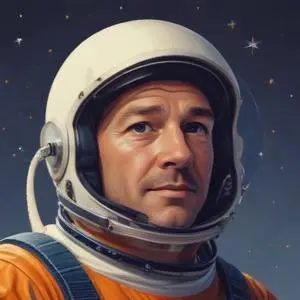
Pete Conrad: The Third Person to Walk on the Moon
Apollo 12 Commander and NASA Astronaut
Pete Conrad, a renowned American astronaut, aeronautical engineer, naval officer, aviator, and test pilot, is best known for commanding the Apollo 12 space mission, where he became the third person to walk on the Moon. This historic achievement earned him a permanent place in the annals of space exploration.
Early Life and Education
Born on June 2, 1930, in Philadelphia, Pennsylvania, Conrad was the third child and first son of Charles Conrad Sr. and Frances De Rappelage Conrad. Despite coming from a well-to-do real estate and banking family, Conrad's early life was marked by challenges, including dealing with dyslexia. However, he overcame this obstacle to earn a Bachelor of Science degree in Aeronautical Engineering from Princeton University, becoming the first Ivy League astronaut.
NASA Career
Conrad's NASA career began in 1962, when he was selected for the agency's second astronaut class. His first spaceflight was on Gemini 5 in 1965, where he set an eight-day space endurance record alongside Command Pilot
Gordon Cooper. Conrad went on to command Gemini 11 in 1966 and Apollo 12 in 1969. His impressive NASA career was marked by several highlights, including:
- Commanding the Apollo 12 mission, where he and Alan Bean became the third and fourth people to walk on the Moon.
- Setting an eight-day space endurance record on Gemini 5.
- Commanding Gemini 11, where he and Richard Gordon performed a series of orbital maneuvers.
- Leading the Skylab 2 mission, the first crewed Skylab mission, in 1973, where he and his crewmates repaired significant launch damage to the Skylab space station.
Awards and Honors
Conrad's numerous achievements were recognized with several awards and honors, including:
- The Congressional Space Medal of Honor in 1978, presented by President Jimmy Carter.
- The NASA Distinguished Service Medal.
- The Navy Distinguished Service Medal.
- The Legion of Merit.
Post-NASA Career and Personal Life
After retiring from NASA and the Navy in 1973, Conrad went on to work in the private sector, holding various executive positions at American Television and Communications Company and McDonnell Douglas. He was a vice president of marketing, senior vice president of marketing, staff vice president of international business development, and vice president of project development during his tenure.
Conrad's personal life was marked by a passion for motorcycles, which ultimately led to his tragic death on July 8, 1999, at the age of 69, due to internal injuries sustained in a motorcycle accident.
Legacy
Pete Conrad's remarkable achievements have left an indelible mark on the history of space exploration. His legacy continues to inspire generations of astronauts, engineers, and scientists, serving as a testament to the power of determination and hard work in overcoming adversity.
Remembering Conrad's iconic words on the Moon, "Whoopee! Man, that may have been a small step for Neil, but that's a long one for me," we honor his memory and celebrate his contributions to human spaceflight.
FAQ
What was Pete Conrads role in the Apollo 12 mission?
Pete Conrad was the commander of the Apollo 12 mission, which successfully landed on the Moons Ocean of Storms in November 1969. He became the third person to walk on the Moons surface.
What is Pete Conrads background in the US Navy?
Pete Conrad was a naval aviator and test pilot in the US Navy before being selected as an astronaut. He graduated from Princeton University with a degree in aeronautical engineering and served as a fighter pilot during the Korean War.
What awards did Pete Conrad receive for his space exploration?
Pete Conrad received numerous awards for his space exploration, including the Congressional Space Medal of Honor, the NASA Distinguished Service Medal, and the US Navys Distinguished Flying Cross.
How did Pete Conrads career as an astronaut impact the space program?
Pete Conrads career as an astronaut played a significant role in the success of the Apollo program, paving the way for future space exploration. He was also a strong advocate for the development of the Space Shuttle program.
What is Pete Conrads legacy in the field of astronautics?
Pete Conrads legacy in the field of astronautics is one of courage, skill, and leadership. He inspired generations of astronauts and engineers, and his contributions to the space program continue to be felt today.