


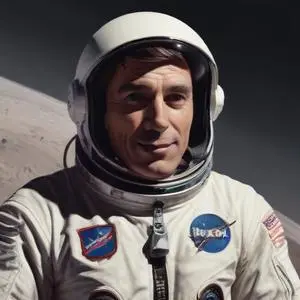
The last person to walk on the Moon, a naval aviator, and astronaut who commanded the Apollo 17 mission, leaving behind a legacy in space exploration.
Eugene Cernan, a name synonymous with space exploration, is renowned for being the last person to walk on the Moon during the Apollo 17 mission in December 1972. This historic feat marked the culmination of a remarkable career spanning over three decades, filled with pioneering achievements and contributions to the field of astronautics.
Born on March 14, 1934, in Chicago, Illinois, Eugene Andrew Cernan grew up with a passion for aviation. He graduated from Purdue University in 1956 with a degree in Aeronautical Engineering, and later earned a Master of Science in Aeronautical Engineering from the U.S. Naval Postgraduate School in 1963.
Cernan's military career began as a naval aviator, flying FJ-4 Fury fighters and A-4 Skyhawk attack aircraft. In 1963, he was selected by NASA as an astronaut candidate for the Gemini program. He flew on three space missions: Gemini 9A, Apollo 10, and Apollo 17, accumulating over 566 hours in space.
On December 11, 1972, Cernan commanded the Apollo 17 mission, accompanied by Ronald Evans and Harrison Schmitt. During their three-day lunar stay, they conducted three extravehicular activities (EVA), collecting samples and conducting experiments. As Cernan stepped out of the lunar module Challenger, he famously declared, "We leave as we came, and, God willing, as we shall return, with peace, and hope for all mankind."
Cernan's experiences in space profoundly impacted his perspective on life and humanity. He believed that space exploration was essential for the advancement of human civilization, and that it could bring nations together in a shared pursuit of discovery. In his autobiography, The Last Man on the Moon, Cernan wrote, "The Earth is a beautiful planet, and we're the only caretakers."
Cernan married Barbara Jean Atchley in 1961, and they had one daughter, Tracy. He passed away on January 16, 2017, at the age of 82. Eugene Cernan's legacy extends beyond his achievements in space; he inspired generations to pursue careers in science, technology, engineering, and mathematics (STEM). His story serves as a testament to human determination, curiosity, and the boundless potential of the human spirit.
Eugene Cernan's remarkable journey serves as a beacon of inspiration, motivating us to continue exploring the vast expanse of space and pushing the boundaries of human achievement.
96 Years Old
First person to walk on the Moon during the Apollo 11 mission, marking a historic milestone in space exploration.
96 Years Old
Second man to walk on the Moon during the Apollo 11 mission, a pioneering astronaut and advocate for space exploration.
70 Years Old
A British singer-songwriter and keyboardist, known for his eclectic and experimental style, blending elements of rock, pop, and electronic music. He's a cult figure among fans of underground music.
91 Years Old
A decorated military officer who walked on the Moon during the Apollo 16 mission, also holding the distinction of being the youngest person to do so at the time.
91 Years Old
A geologist-astronaut who walked on the Moon during the Apollo 17 mission and later became a US Senator, known for his scientific contributions and space exploration achievements.
94 Years Old
One of the 12 humans to walk on the Moon during NASA's Apollo program, known for his moonwalk during Apollo 12 and later becoming a painter, capturing the beauty of space through art.
96 Years Old
Led the third manned mission to land on the Moon, Apollo 12, and became the third person to walk on its surface. Known for his bold and fearless approach to space exploration.
Born in 1921
A renowned surgeon who wrote bestselling novels, including "Doctor in the House," which was adapted into a successful film and TV series, offering a humorous glimpse into medical life.
