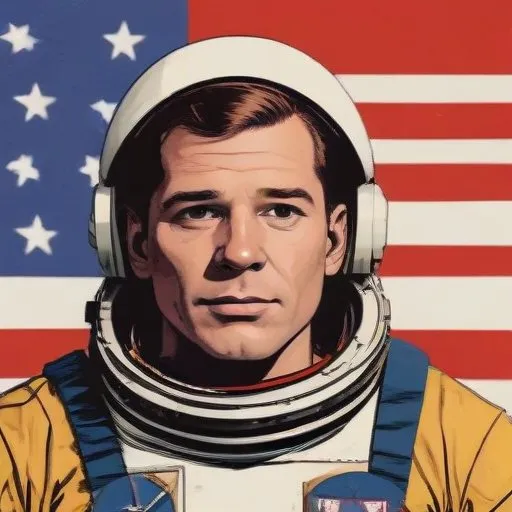
Ronald Evans: The Unsung Hero of the Apollo 17 Mission
Astronaut, Engineer, and American Hero
Ronald Evans is best known for his remarkable journey as the Command Module Pilot of the Apollo 17 mission, where he spent a record 147 hours and 43 minutes in lunar orbit, making him the last person to orbit the Moon alone. This monumental achievement cemented his place in the annals of space exploration history.
Early Life and Education
Born on November 10, 1933, in St. Francis, Kansas, Evans grew up with a passion for flight and engineering. He earned a Bachelor of Science degree in electrical engineering from the University of Kansas in 1956 and later received a Master of Science degree in aeronautical engineering from the U.S. Naval Postgraduate School in 1964.
Navy Career and Astronaut Selection
Evans joined the U.S. Navy in 1956, where he served as a fighter pilot and flew combat missions during the Vietnam War. He achieved the rank of captain before retiring in 1976. In 1966, he was selected as an astronaut by NASA as part of Astronaut Group 5, a talented group of individuals who would go on to make significant contributions to space exploration.
Apollo 17 Mission and Record-Breaking Achievements
On December 7, 1972, Evans embarked on the Apollo 17 mission alongside Commander Gene Cernan and Lunar Module Pilot
Harrison Schmitt. While Cernan and Schmitt descended to the Moon's surface, Evans remained in orbit, conducting scientific experiments and capturing iconic photographs of the Earth. During the mission, he broke two records: the most time spent in lunar orbit and the most lunar orbits (75) by a single spacecraft.
Extravehicular Activity and Spacewalk
On the return journey to Earth, Evans performed an extravehicular activity (EVA) to retrieve film cassettes from the service module. This spacewalk, conducted at a distance of over 200,000 miles from Earth, remains one of only three deep space EVAs in history.
Legacy and Impact
Ronald Evans' remarkable achievements have inspired generations of astronauts, engineers, and scientists. His contributions to the Apollo 17 mission and his record-breaking spacewalk have left an indelible mark on the history of space exploration. As we continue to push the boundaries of space travel, Evans' legacy serves as a reminder of the importance of human spaceflight and the incredible feats that can be achieved with determination and hard work.
Awards and Honors
Evans received numerous awards and honors for his service, including the Navy Distinguished Service Medal, the Legion of Merit, and the NASA Distinguished Service Medal.
Personal Life and Later Years
After retiring from NASA in 1977, Evans went on to work in the coal industry. He passed away on April 7, 1990, but his legacy continues to inspire and motivate people around the world.
Trivia and Fun Facts
- Evans was nicknamed "Ron" by his fellow astronauts.
- He was an avid photographer and took many stunning photographs of the Earth during the Apollo 17 mission.
- Evans was the first astronaut to perform an EVA in deep space.
Ronald Evans' remarkable story is a testament to the power of human ingenuity, determination, and exploration. His contributions to space travel have left a lasting impact on the world, and his legacy will continue to inspire generations to come.
FAQ
What was Ronald Evans role in the Apollo 17 mission?
Ronald Evans was the command module pilot of the Apollo 17 mission, playing a crucial role in the success of the mission and earning him a place in American space history.
What were Ronald Evans achievements as an astronaut?
Ronald Evans was a highly accomplished astronaut, having flown on the Apollo 17 mission and contributing to the success of the United States space program.
What is Ronald Evans legacy in space exploration?
Ronald Evans legacy in space exploration is one of bravery, skill, and dedication, inspiring future generations of astronauts and space explorers.
What did Ronald Evans study in college?
Ronald Evans studied aeronautical engineering at the University of Kansas, laying the foundation for his successful career as an astronaut and engineer.
How did Ronald Evans become an astronaut?
Ronald Evans became an astronaut after serving as a naval aviator and test pilot, and was selected by NASA for the astronaut program in 1966.