


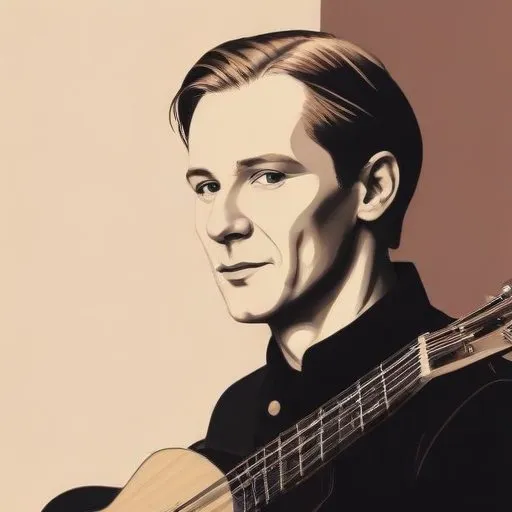
A Swedish troubadour celebrated for his poetic lyrics and soothing lute melodies, evoking a sense of nostalgia and romanticism. His music is deeply rooted in Swedish folklore and culture.
Evert Taube is widely regarded as one of Sweden's most respected musicians and the foremost troubadour of the Swedish ballad tradition in the 20th century. He is renowned for his captivating songs, enchanting storytelling, and his ability to evoke the essence of the Swedish archipelagoes and the Mediterranean.
Born on March 12, 1890, in Gothenburg, Taube spent his childhood on the picturesque island of Vinga, Västergötland, where his father, Carl Gunnar Taube, was the lighthouse keeper. This idyllic setting would later inspire many of his songs and stories. Taube's mother, Julia Sofia Jacobsdotter, also played a significant role in shaping his early years.
At the tender age of 19, Taube embarked on a two-year sailing journey around the Red Sea, Ceylon, and South Africa. This experience would later influence his music and writing, as he collected sailors' songs and tales from his travels. In 1908, on Christmas Eve, he performed "Turalleri, piken fra Hamburg" on board the Norwegian ship SS Bergen, marking the beginning of his career as a singer-songwriter.
Between 1910 and 1915, Taube spent five years in Argentina, where he developed a fascination with Latin American music. During this period, he worked as a foreman supervising workers who were digging canals designed to prevent flooding on the vast plains of the Pampas. Although often mistakenly believed to have worked as a gaucho cowboy, Taube's experiences in Argentina had a profound impact on his music, and he later introduced the Argentinian tango to Sweden in the 1920s.
Taube is perhaps best known for his idyllic portrayals of the Swedish archipelagoes and the Mediterranean, resonating with every Swedish four-week holiday tourist. However, he also penned the powerful anti-fascist and anti-war poem "Mälaren och Maria Pia," condemning the Italian war in Abyssinia in the late 1930s. Additionally, he composed the anthem of the budding environmental movement in the 1970s, " Änglamark," originally written for the 1971 film "The Apple War."
Taube received numerous accolades for his contributions to Swedish music and literature. His literary secretary, Inga-Britt Fredholm, worked closely with him from the late 1950s onwards, ensuring the preservation of his works.
Evert Taube's legacy extends far beyond his own music and writings. He has inspired generations of Swedish musicians, writers, and artists, leaving an indelible mark on Swedish cultural heritage. His music and stories continue to captivate audiences, evoking the essence of the Swedish archipelagoes and the Mediterranean.
In conclusion, Evert Taube's life and works are a testament to the power of music, literature, and storytelling. His legacy continues to inspire and captivate audiences, cementing his place as one of Sweden's most beloved and respected troubadours.
Born in 1924
A Swedish singer and actress who was known as the "Swedish Swing Queen" for her jazz and swing music, and for being the first non-American to perform at the Cotton Club in Harlem.
