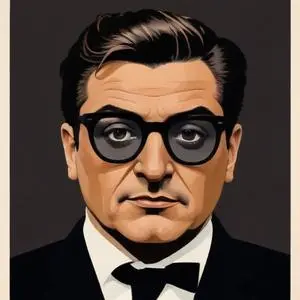
Federico Fellini: The Maestro of Whimsy and Fantasy
A Master of Cinematic Storytelling
Federico Fellini is renowned for his innovative and imaginative filmmaking style, which masterfully blends fantasy, baroque imagery, and earthiness. He is widely regarded as one of the greatest and most influential filmmakers of all time, leaving an indelible mark on the world of cinema.
Early Life and Inspiration
Born on January 20, 1920, in Rimini, Italy, Fellini grew up in a middle-class family with a rich cultural heritage. His love for storytelling and visual arts was nurtured by his mother, Ida Barbiani, who encouraged his creative pursuits. Fellini's early life was marked by a fascination with circus performances, puppet shows, and comics, which would later influence his cinematic style.
Breakthrough and Acclaim
Fellini's breakthrough film,
I Vitelloni (1953), won the Silver Lion at the Venice Film Festival, launching his career as a prominent filmmaker. His subsequent films,
La Strada (1954) and
Nights of Cabiria (1957), solidified his reputation as a master of storytelling, earning him multiple Academy Award nominations.
Iconic Films and Collaborations
Fellini's most iconic films include:
- La Dolce Vita (1960), a poignant exploration of the human condition, which won the Palme d'Or at the Cannes Film Festival
- 8 1/2 (1963), a semi-autobiographical masterpiece that won the Academy Award for Best Foreign Language Film
- Juliet of the Spirits (1965), a surreal and fantastical tale of love and identity
- Fellini Satyricon (1969), a visually stunning adaptation of Petronius' classic novel
- Roma (1972), a love letter to the eternal city
- Amarcord (1973), a nostalgic and whimsical portrayal of small-town life
- Fellini's Casanova (1976), a lavish and fantastical biopic of the legendary libertine
Awards and Legacy
Throughout his illustrious career, Fellini received numerous accolades, including:
- Four Academy Awards for Best Foreign Language Film
- Five nominations for Best Director
- The Palme d'Or, Golden Lion, and Moscow International Film Festival awards
- A lifetime achievement honorary award at the 65th Academy Awards
Fellini's legacy extends beyond his films, inspiring generations of filmmakers, artists, and writers. His influence can be seen in the work of directors like
Martin Scorsese,
Francis Ford Coppola, and
Terry Gilliam, among many others.
Personal Philosophies and Inspirations
Fellini's creative vision was shaped by his fascination with dreams, mythology, and the human psyche. He often cited his influences as ranging from Italian neorealism to German Expressionism, and from literature to fine art. His films often explored themes of identity, morality, and the search for meaning in a chaotic world.
Controversies and Public Perception
Fellini's unapologetic individuality and artistic vision often sparked controversy and criticism. He was accused of being self-indulgent, extravagant, and even narcissistic. However, these criticisms only fueled his creative fire, as he continued to push the boundaries of cinematic storytelling.
Final Years and Legacy
Fellini passed away on October 31, 1993, but his films continue to enchant audiences worldwide. His legacy is a testament to the power of imagination, creativity, and the human spirit. As a master of fantasy and whimsy, Federico Fellini remains an eternal source of inspiration for generations to come.
FAQ
What was Federico Fellinis style of filmmaking?
Federico Fellini was an Italian director and screenwriter known for his unique and fantastical style of filmmaking. He often explored themes of identity, morality, and the human condition in his films.
What are some of Federico Fellinis most famous films?
Some of Federico Fellinis most famous films include La Dolce Vita, 8 1/2, Roma, and Amarcord. These films are known for their vivid imagery, complex characters, and exploration of Italian culture.
How did Federico Fellinis background influence his filmmaking?
Federico Fellinis background in cartooning and satire influenced his filmmaking style, which often incorporated elements of fantasy and surrealism. His experiences during World War II also shaped his worldview and informed his films.
What was Federico Fellinis relationship with Marcello Mastroianni?
Federico Fellini had a close professional and personal relationship with Italian actor Marcello Mastroianni, who starred in several of his films, including La Dolce Vita and 8 1/2.
How did Federico Fellini influence Italian neorealism?
Federico Fellinis films, particularly La Strada and Nights of Cabiria, helped to shape the Italian neorealist movement, which focused on portraying the lives of everyday people in post-war Italy.