


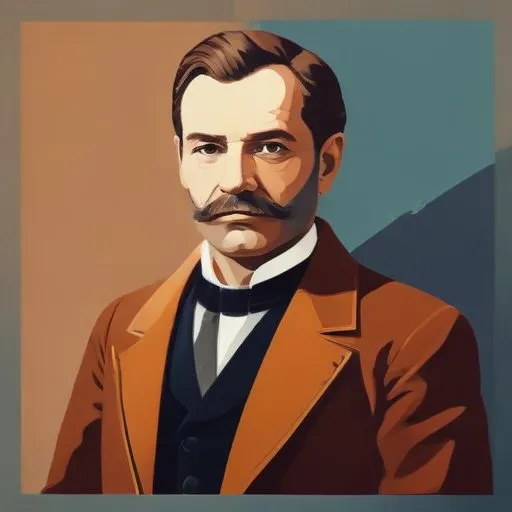
A 19th-century geologist who explored and mapped New Zealand's natural wonders, making significant contributions to the field of geology. His work remains crucial for understanding the region's unique geological features.
Ferdinand von Hochstetter, a German-Austrian geologist, is renowned for his groundbreaking contributions to the field of geology, particularly in the exploration and mapping of New Zealand's unique landscapes. His meticulous surveys and reports established him as a leading authority in the field, earning him a reputation that would span decades.
Born on April 30, 1829, in Esslingen, Germany, Hochstetter's fascination with geology began at a young age. He received his early education at the Evangelical Seminary in Maulbronn, before pursuing advanced studies at the University of Tübingen. Under the guidance of Friedrich August von Quenstedt, Hochstetter's interest in geology deepened, ultimately leading him to obtain his doctorate degree and a traveling scholarship.
In 1852, Hochstetter joined the Imperial Geological Survey of Austria, where he spent four years conducting detailed surveys in Bohemia, the Bohemian Forest, and the Fichtel Hills.
His exceptional reports earned him a spot as geologist to the Novara expedition (1857-1859), a voyage that took him around the world and brought him to New Zealand.
During his nine-month stay in New Zealand, Hochstetter conducted the country's first geological survey, producing invaluable insights into the region's unique landscapes, including the now-lost Pink and White Terraces.
Upon his return, Hochstetter became professor of mineralogy and geology at the Imperial-Royal Polytechnic Institute in Vienna, a position he held until 1875, during which he also served as rector from 1874 to 1875.
Hochstetter's work was characterized by his meticulous attention to detail and commitment to scientific rigor. His surveys and reports not only expanded the field of geology but also demonstrated his passion for understanding the natural world. His work embodied the spirit of scientific inquiry, reflecting his belief in the importance of empirical observation and rigorous analysis.
Hochstetter's contributions to the field of geology have had a lasting impact on our understanding of the natural world. His work in New Zealand, in particular, has provided valuable insights into the region's unique geological features, informing the development of industries such as mining and tourism. Furthermore, his pioneering spirit has inspired generations of geologists and scientists, encouraging them to explore and protect the natural world.
During his time in New Zealand, Hochstetter formed a lifelong friendship with German scientist Julius von Haast, a testament to the power of collaboration and camaraderie in scientific pursuits. His encounter with Arthur Purchas, a polymath who convinced him to stay in New Zealand, highlights the significance of chance encounters in shaping the course of one's life.
Hochstetter's legacy extends beyond his scientific contributions. His work in New Zealand, conducted during a pivotal period of colonial expansion, underscores the complex relationships between science, imperialism, and indigenous cultures. As a testament to his lasting impact, Hochstetter's survey diary was reverse-engineered between 2016 and 2020, providing the coordinates of the Pink, Black, and White Terraces, a remarkable example of the enduring value of his work.
Ferdinand von Hochstetter's remarkable life and career serve as a reminder of the power of human curiosity and the importance of scientific inquiry in understanding the natural world. His pioneering spirit, meticulous attention to detail, and commitment to rigor have left an indelible mark on the field of geology, inspiring generations to come.
Born in 1809
Developed the theory of evolution through natural selection, revolutionizing our understanding of life on Earth. This groundbreaking idea transformed the fields of biology, ecology, and beyond.
Born in 1823
A pioneering naturalist who discovered evolution through natural selection, independently of Charles Darwin, and contributed significantly to the field of biogeography.
Born in 1817
A renowned botanist and explorer who contributed significantly to the discovery and classification of numerous plant species, particularly in the Himalayas and Antarctica. His work laid the foundation for modern botanical research.
Born in 1810
A pioneering botanist who contributed significantly to the development of American botany, particularly in the fields of plant classification and evolution.
