


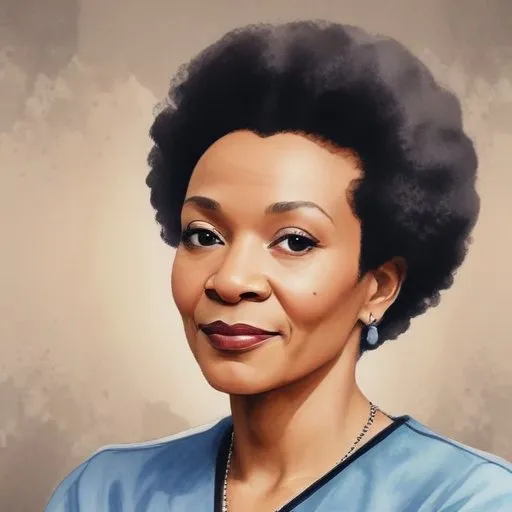
A psychiatrist and author who developed the Cress Theory of Color-Confrontation, which posits that racism is a result of white people's fear of genetic annihilation, and wrote the book "The Isis Papers".
Frances Cress Welsing, a trailblazing psychiatrist, is best known for her groundbreaking work on the Black Melanin Theory and her thought-provoking writings on racism, white supremacy, and the consequences of globalization. Through her seminal essay, "The Cress Theory of Color-Confrontation and Racism (White Supremacy)" and her book, "The Isis Papers: The Keys to the Colors," Welsing has contributed significantly to the discourse on race relations and social justice.
Born Frances Luella Cress on March 18, 1935, in Chicago, Illinois, Welsing grew up in a family of educators and healthcare professionals. Her father, Henry Noah Cress, was a physician, and her mother, Ida Mae Griffin, was a teacher. Welsing earned her Bachelor of Science degree from Antioch College in Yellow Springs, Ohio, in 1957. She then pursued her medical degree at Howard University Medical School, where she met her future husband, Johannes Kramer Welsing, a Ghanaian national. Welsing earned her M.D. in 1962.
In 1969, Welsing formulated her groundbreaking theory, which posits that white supremacy is a result of fear and insecurity stemming from the lack of melanin in white skin. This theory, which was self-published in 1970, challenged traditional notions of racism and sparked intense debates. The theory was later published in the May 1974 edition of The Black Scholar, cementing Welsing's reputation as a progressive thinker.
Welsing's magnum opus, The Isis Papers: The Keys to the Colors, was published in 1991. This compilation of essays, written over 18 years, offers a comprehensive exploration of race relations, globalization, and the impact of white supremacy on society. The title, inspired by the ancient Egyptian goddess Isis, reflects Welsing's fascination with African culture and her desire to reclaim pride in Black identity.
Welsing's work is characterized by her commitment to social justice and her unflinching critique of systemic racism. Her philosophical contributions have inspired generations of scholars, activists, and thinkers. Her beliefs emphasize the importance of understanding the roots of white supremacy and the need for collective action to dismantle oppressive systems.
Welsing's ideas have had a profound impact on modern society, influencing scholars, activists, and artists. Her work has been cited in academic literature, and her theories have been debated in intellectual circles. Welsing's legacy extends beyond the academic sphere, inspiring social movements and fueling conversations about race and identity.
Frances Cress Welsing's life's work has left an indelible mark on our understanding of race, identity, and social justice. Her unwavering commitment to challenging the status quo has inspired generations of thinkers and activists. As we continue to grapple with the complexities of racism and white supremacy, Welsing's ideas remain a timely reminder of the importance of critical thinking, self-reflection, and collective action.
85 Years Old
A prominent figure in the Civil Rights Movement, advocating for Black Power and self-defense, and famously coining the term "Black Power" in 1966. Known for his radical approach to achieving racial equality.
Born in 1925
A prominent figure in the Civil Rights Movement, advocating for African American rights and self-defense, and a powerful orator who inspired a generation.
97 Years Old
A prominent leader in the civil rights movement, advocating for racial equality and social justice through nonviolent means, leaving a lasting impact on American history.
Born in 1913
Refused to give up her seat on a Montgomery, Alabama bus to a white person, sparking the Montgomery Bus Boycott, a pivotal event in the Civil Rights Movement.
82 Years Old
A prominent civil rights activist, academic, and author who has been a vocal advocate for racial and gender equality, and an icon of black feminism. Known for her work on prison reform and her involvement in the Black Panther Party.
90 Years Old
Co-founder of the Black Panther Party, a radical organization that fought for African American rights and empowerment in the 1960s and 1970s, known for his activism and leadership during a tumultuous period in American history.
84 Years Old
Co-founder of the Black Panther Party, a revolutionary socialist organization that advocated for African American empowerment and challenged police brutality in the 1960s and 1970s. Known for his charismatic leadership and radical ideology.
Born in 1897
Leader of the Nation of Islam, promoting black empowerment and separatism through a unique blend of Islam and black nationalism. Known for his controversial teachings and influence on prominent figures like Malcolm X.
