


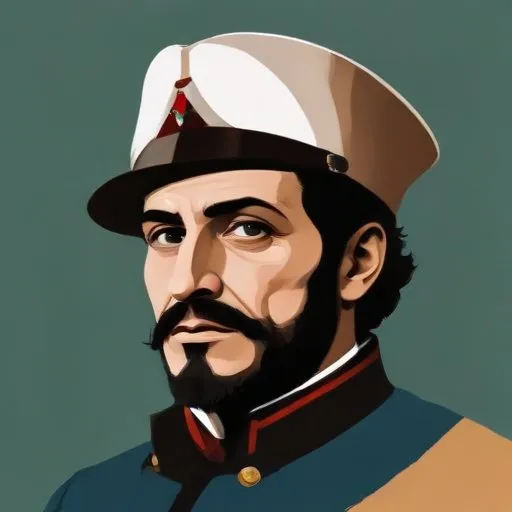
Led a rebellion against the French occupation of Naples in 1799, known for his bravery and military tactics.
Francesco Bentivegna, a renowned Italian patriot, led a series of daring revolts against the Bourbon rulers in Sicily between 1848 and 1856. Known for his unwavering courage and unrelenting passion for Italian independence, Bentivegna became a symbol of resistance against foreign occupation, inspiring countless revolutionaries and patriots across the region.
Born on March 4, 1820, in Corleone, Sicily, Francesco Bentivegna was the son of Giliberto de Cordova, Marquis of Giostra, and Teresa de Cordova, from the illustrious Bourbon-Orleans family. The Bentivegna family had a long history of involvement with the Roman Catholic Church, with records dating back to St. Benedict. Initially, his parents wanted Bentivegna to become a priest, following in the family's tradition of religiosity.
In 1848, Bentivegna joined the fight against the Bourbon rulers in Palermo, demonstrating remarkable bravery and earning the respect of the provisional governor, who appointed him military governor of the Corleone district. Refusing to accept payment for his services, Bentivegna remained committed to the cause of Italian independence. However, the Bourbon forces reoccupied Palermo just 16 months later.
When the Bourbon governor offered amnesty to those who would pledge fealty to the French rulers, Bentivegna refused to surrender, choosing instead to continue his fight for freedom. In 1850, he attempted another coup against the Bourbon government, barely escaping capture and forced to live as a wanted fugitive for over two years.
In 1856, Bentivegna, along with fellow revolutionary Salvatore Spinuzza, planned a full-scale uprising against the Bourbon government. With the support of Giuseppe Mazzini and his group, La Giovine Italia, Bentivegna organized squadre of peasants to attack Mezzojuso and Villafrati, while Spinuzza focused on Cefal. However, before the uprising could succeed, Bentivegna was betrayed by Ignazio Milone, a Corleonese who had been promised a knighthood, and arrested on February 25, 1853.
Released from prison on July 25, 1856, Bentivegna continued to advocate for Italian independence, realizing that his time was running out. On December 20, 1856, he was executed, but his sacrifice would not be in vain, as his courageous struggle inspired a new generation of patriots to fight for Italian unity.
Francesco Bentivegna's courageous fight for Italian independence has left an indelible mark on the country's history. His unwavering commitment to the cause of freedom and his refusal to surrender in the face of adversity have made him a revered figure in Sicily and beyond. Today, Bentivegna's legacy serves as a beacon of inspiration for those seeking to challenge oppression and fight for their rights.
Francesco Bentivegna's remarkable story serves as a testament to the power of courage, perseverance, and conviction in the face of adversity. His legacy continues to inspire generations, reminding us of the importance of standing up against oppression and fighting for our rights.
Born in 1807
Led a military campaign to unify Italy, becoming a national hero and symbol of Italian independence. He's also known for his charisma and unconventional style.
Born in 1805
A leading figure in the Italian unification movement, he advocated for a unified Italian republic and inspired similar movements across Europe. His ideas influenced modern nationalism and democracy.
Born in 1842
The 13th Prime Minister of Italy, a master of political maneuvering, dominated Italian politics in the early 20th century with his flexible and pragmatic approach. He's most known for his ability to maintain power and stability during a time of great social and economic change.
