


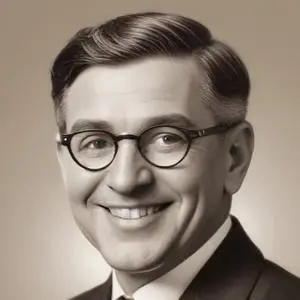
A Nobel Peace Prize-winning diplomat who brokered the 1928 Kellogg-Briand Pact, outlawing war as an instrument of national policy. He played a crucial role in promoting international cooperation and peace.
Frank Billings Kellogg, an American lawyer, politician, and statesman, is best known for co-authoring the Kellogg-Briand Pact, a groundbreaking treaty that outlawed war and earned him the Nobel Peace Prize in 1929. This monumental achievement cemented Kellogg's legacy as a champion of international cooperation and a pioneer in shaping global politics.
Born on December 22, 1856, in Potsdam, New York, Kellogg was the son of Abigail Billings and Asa Farnsworth Kellogg. He moved to Minnesota in 1865 and pursued a career in law, reading law and beginning his practice in Rochester, Minnesota, in 1877. Kellogg's early career saw him serving as city attorney of Rochester (1878-1881) and county attorney for Olmsted County, Minnesota (1882-1887).
In 1905, Kellogg joined the federal government when Theodore Roosevelt asked him to prosecute a federal antitrust case. This marked the beginning of his rise to prominence, as he went on to play a crucial role in several high-profile cases, including the prosecution of Union Pacific Railroad under the Sherman Antitrust Act. His most notable case was Standard Oil Co. of New Jersey v. United States (1911), which solidified his reputation as a leading antitrust lawyer.
In 1916, Kellogg was elected as a Republican to the United States Senate from Minnesota, serving from 1917 to 1923. During his tenure, he supported the ratification of the Treaty of Versailles, placing him among the few Republicans who did so. After losing his reelection bid in 1922, Kellogg went on to serve as a delegate to the Fifth International Conference of American States at Santiago, Chile, in 1923. In 1924, he was appointed Ambassador to Great Britain, further solidifying his status as a respected statesman.
In 1928, Kellogg co-authored the Kellogg-Briand Pact with French foreign minister Aristide Briand, a treaty that outlawed war and promoted peaceful resolution of international conflicts. This landmark achievement earned Kellogg the Nobel Peace Prize in 1929, recognizing his tireless efforts to promote global understanding and cooperation.
Frank B. Kellogg's legacy extends far beyond his Nobel Prize. He played a pivotal role in shaping global politics, promoting international cooperation, and advocating for peaceful resolution of conflicts. His work continues to inspire generations of diplomats, politicians, and peace activists, cementing his place in history as a champion of peace and cooperation.
Frank B. Kellogg's remarkable life and achievements serve as a testament to the power of dedication, perseverance, and a commitment to promoting global peace and cooperation. His legacy continues to inspire and shape the world we live in today.
Born in 1865
The 29th President of the United States, a journalist-turned-politician, led the country through a period of post-war prosperity and scandalous corruption. He's infamous for his administration's numerous scandals and his own extramarital affairs.
Born in 1872
The 30th President of the United States, a lawyer and politician, led the country through a period of economic prosperity and limited government intervention, earning the nickname "Silent Cal" for his frugal and humble nature. He's most known for his minimalist approach to governance and tax cuts.
Born in 1874
The 31st President of the United States was a humanitarian and politician who led the country through the Great Depression and is known for his humanitarian efforts and infrastructure development. He's also infamous for his inability to mitigate the economic crisis.
Born in 1867
A prominent figure in American politics, serving as Secretary of State and playing a key role in shaping foreign policy during World War II. He's also known for his advocacy of international cooperation and collective security.
Born in 1862
A prominent lawyer and politician who served as the 44th Secretary of State, known for his influential decisions and diplomatic efforts in shaping international relations. He played a key role in resolving the Mexican Revolution crisis.
Born in 1845
A prominent lawyer and politician who served as Secretary of State, earning a Nobel Peace Prize for his diplomatic efforts. He's most known for his work in international arbitration and conflict resolution.
98 Years Old
A prolific character actor with a distinctive voice, he played memorable roles in film and television, including the iconic character of Gary Jenkins in the TV series "Automan".
