


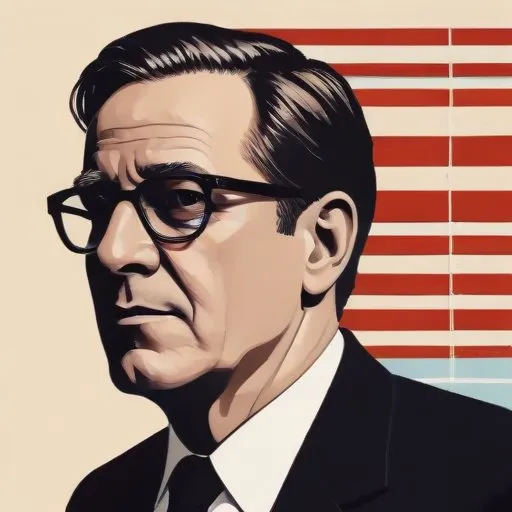
A pioneering television journalist who reported on significant events, including the assassination of President John F. Kennedy and the Apollo 11 moon landing.
Frank McGee, a renowned American television journalist, is best known for his work with NBC from the late 1950s into the early 1970s, providing vivid and descriptive coverage of pivotal events that shaped the nation. His distinctive reporting style and ability to paint a picture with words made him a household name, earning him a spot among the most prominent newsmen of his time.
Born on September 12, 1921, in Monroe, Louisiana, McGee was raised in Norman, Oklahoma, where his father worked in the oil fields. Before pursuing a career in journalism, McGee served in the Oklahoma National Guard in 1940 and later in the U.S. Army during World War II. After the war, he attended the University of California and the University of Oklahoma, laying the foundation for his future in broadcast news.
McGee's broadcast news career began in 1946 at KGFF in Shawnee, Oklahoma, where he worked under the stage name Mack Rogers. His talent and dedication soon led him to WKY-TV (now KFOR-TV) in Oklahoma City, Oklahoma, where he adopted his real name and eventually became the news director. In 1955, the owners of WKY purchased WSFA-TV in Montgomery, Alabama, and McGee was sent there as news director, marking the beginning of his association with NBC.
As the civil rights movement gained national attention, McGee's coverage of the events caught the attention of NBC, which offered him a position with the network in New York City. He went on to become a floor correspondent for the national conventions of both political parties in 1960, 1964, and 1968, alongside other notable NBC newsmen like John Chancellor, Edwin Newman, and Sander Vanocur. McGee's most notable moment came when he moderated the second debate between presidential candidates John F. Kennedy and Richard Nixon on October 7, 1960, in Washington, D.C., a debate that many believed swayed the election in favor of Kennedy among television viewers.
Throughout his career, McGee received numerous awards and honors for his exceptional reporting, including several Emmy Awards and a Peabody Award. He was also inducted into the Oklahoma Journalism Hall of Fame in 1971.
Frank McGee's legacy in American journalism is undeniable. His unique storytelling ability and commitment to reporting the truth inspired a generation of journalists and continue to influence the industry today. McGee passed away on April 17, 1974, but his impact on the world of journalism will be felt for years to come.
99 Years Old
A renowned news anchor and journalist, known for his distinctive voice and reporting on significant events, including the assassination of JFK and the Watergate scandal.
Born in 1920
A renowned news anchor and correspondent who reported on significant historical events, including World War II and the Kennedy assassination, and was a pioneer of television journalism.
Born in 1911
Co-anchor of NBC's Huntley-Brinkley Report, a pioneering news program that set the standard for evening news broadcasts, known for his folksy, down-to-earth style.
Born in 1916
Legendary news anchor and voice of authority, known for delivering trusted and unbiased reporting during pivotal moments in American history, including the Apollo 11 moon landing.
Born in 1908
Pioneering broadcast journalist who exposed Senator Joseph McCarthy's communist witch hunt, setting a high standard for fearless reporting.
Born in 1914
A renowned journalist and actor who reported on historic events like the Civil Rights Movement and World War II, and appeared in films and TV shows like "The Twilight Zone".
Born in 1906
A pioneering news anchor who set the standard for television journalism, known for his iconic catchphrase "That's the way it is."
