


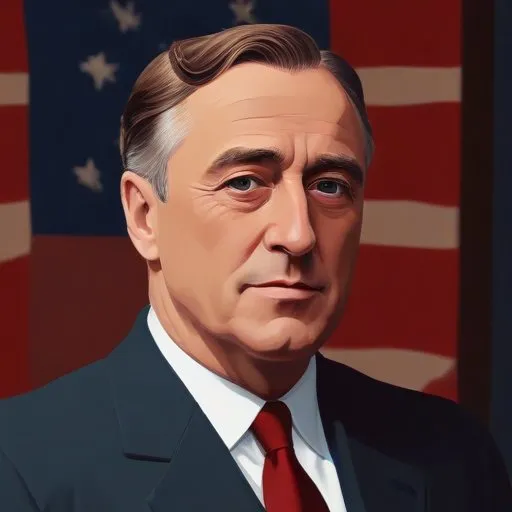
Son of President Franklin D. Roosevelt, he served as a congressman and undersecretary of the Navy, playing a key role in shaping post-WWII naval policy. He was also a lawyer and businessman.
Franklin Delano Roosevelt Jr., son of the 32nd President of the United States, Franklin D. Roosevelt, was an American politician, businessman, and conservationist who made his mark in public service and environmental protection. He is best known for his role as a member of the United States House of Representatives from New York's 20th congressional district and his tireless efforts to preserve the natural beauty of the Hudson River Valley.
Born on August 17, 1909, in Campobello Island, New Brunswick, Canada, Franklin Delano Roosevelt Jr. was the fifth of six children born to Franklin and Eleanor Roosevelt. He grew up surrounded by the values of public service and social responsibility, which would shape his future endeavors. Roosevelt Jr. attended Groton School and then graduated from Harvard University in 1931 with a degree in economics.
Roosevelt Jr. began his political career in 1946, serving as a Democratic member of the New York State Assembly. In 1949, he was elected to the United States House of Representatives, where he represented New York's 20th congressional district until 1955. During his tenure, he focused on issues related to agriculture, conservation, and education.
Roosevelt Jr. was a passionate advocate for environmental protection, particularly in the Hudson River Valley. He worked tirelessly to establish the Hudson River Valley Commission, which aimed to preserve the region's natural beauty and promote sustainable development. He also played a key role in the creation of the Home of Franklin D. Roosevelt National Historic Site, which protects the Roosevelt family's beloved Springwood estate in Hyde Park, New York.
After leaving politics, Roosevelt Jr. dedicated his life to conservation and philanthropy. He served as the president of the Franklin D. Roosevelt Memorial Foundation, which aimed to preserve the legacy of his father's New Deal policies and promote sustainable development. He also worked with the Nature Conservancy, helping to protect millions of acres of land and habitat across the United States.
Roosevelt Jr. was a devoted philanthropist, supporting various environmental and educational organizations. He served on the board of the New York State Environmental Facilities Corporation, which provided funding for environmental infrastructure projects throughout the state.
Roosevelt Jr. married Suzanne Perrin in 1932, and they had three children together. He was a licensed pilot and enjoyed sailing, hiking, and exploring the great outdoors. In his later years, he suffered from Parkinson's disease, but continued to advocate for environmental causes until his passing on August 17, 1997, on his 88th birthday.
Roosevelt Jr.'s life was a testament to the power of public service, environmental stewardship, and perseverance. His legacy continues to inspire future generations to take action in protecting our planet and promoting sustainable development.
Franklin Delano Roosevelt Jr.'s commitment to environmental protection and conservation has left a lasting impact on the Hudson River Valley and beyond. His tireless advocacy for sustainable development and his philanthropic efforts have inspired countless individuals to take action in protecting our planet.
Today, the Hudson River Valley Commission and the Franklin D. Roosevelt Memorial Foundation continue to thrive, thanks in part to Roosevelt Jr.'s dedication to preserving the natural beauty of the region. His legacy serves as a reminder of the importance of environmental stewardship and the power of individual action in shaping a more sustainable future.
Franklin Delano Roosevelt Jr.'s life was a testament to the power of public service, environmental stewardship, and perseverance. His legacy continues to inspire future generations to take action in protecting our planet and promoting sustainable development.
Born in 1882
Led the United States through the Great Depression and World War II, implementing a series of reforms known as the New Deal and helping to establish the country as a global superpower.
Born in 1884
A humanitarian and politician who championed human rights, women's empowerment, and social justice, leaving a lasting impact on American politics and international relations.
Born in 1917
The 35th President of the United States was a charismatic leader who navigated the country through the Cuban Missile Crisis and advocated for civil rights, leaving a lasting legacy in American politics.
Born in 1925
A Navy officer, lawyer, and politician who served as US Attorney General, playing a key role in the Civil Rights Movement and advocating for social justice. He was a prominent figure in American politics during the 1960s.
94 Years Old
A prominent figure in American politics, serving nearly 47 years in the Senate, championing liberal causes, and playing a significant role in shaping the country's healthcare and civil rights policies.
Born in 1908
The 36th President of the United States, a skilled politician and leader, played a crucial role in passing landmark civil rights legislation, including the Civil Rights Act and Voting Rights Act.
Born in 1884
The 33rd President of the United States, a strong leader who made tough decisions, including dropping atomic bombs on Japan and establishing the Marshall Plan to rebuild Europe after WWII.
Born in 1890
Led the Allied forces to victory in World War II and later served as President, maintaining peace and prosperity during the Cold War era. He's known for his strategic leadership and diplomatic skills.
