


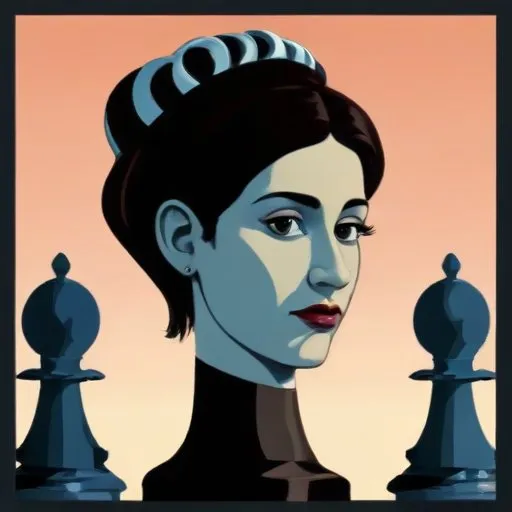
A renowned 18th-century chess master and opera composer, celebrated for his exceptional skill in both fields, particularly his chess strategies and musical works that showcased his innovative style.
FranoisAndr Danican Philidor was a French composer and chess player who made significant contributions to the early development of the opéra comique and is widely regarded as the best chess player of his age. His book, Analyse du jeu des échecs, was considered a standard chess manual for at least a century, and his legacy continues to inspire musicians and chess enthusiasts alike.
Philidor was born on September 7, 1726, into a musical family. His grandfather, Jean Danican Philidor, was a musician who had been given the nickname "Philidor" by Louis XIII due to his skill on the oboe. Philidor joined the royal choir of Louis XV at the age of six and began composing his own music at 11. His music career took him to Paris, where he lived and worked as a performer, teacher, and music copyist, counting among his students the Bohemian composer and pianist Ludwig Wenzel Lachnith.
Philidor's interest in chess was sparked during his time in the royal choir, where the singers would play chess to pass the time while waiting for the king to arrive. He quickly became a skilled player, and his book, Analyse du jeu des échecs, published in 1749, cemented his reputation as a chess master. The book's popularity extended beyond France, and he was recognized as the best chess player of his age. A well-known chess opening, an endgame position, and a checkmate method are all named after him.
In the 1740s and 1750s, Philidor traveled extensively, visiting the Netherlands, England, and Italy. These travels had a significant impact on his music, which was criticized by some for being too "Italianate." However, his experiences abroad also influenced his composition style, which became more eclectic and innovative. During his time in London, he moved in the same circles as Dr. Johnson and Dr. Burney, and his music was performed for the British royal family.
Philidor's contributions to music and chess have had a lasting impact on both fields. His opéra comiques, such as Le sorcier, continue to be performed today, and his Analyse du jeu des échecs remains a seminal work in the world of chess. His legacy extends beyond his own achievements, as he inspired future generations of musicians and chess players.
Philidor's life was a testament to the power of dedication and hard work. His passion for music and chess drove him to excel in both fields, and his legacy continues to inspire and delight audiences today.
Born in 1775
A pioneer in the field of electromagnetism, he formulated fundamental laws that describe the relationship between electric currents and magnetic fields. His work laid the foundation for many modern technologies, including electric motors and generators.
Born in 1768
A French historian and politician who served as Minister of Foreign Affairs, known for his influential writings on French history and politics, shaping the country's identity and foreign policy.
Born in 1749
Developed nebular hypothesis of the origin of the solar system and formulated Laplace's equation, a fundamental concept in mathematics and physics. He's considered the founder of celestial mechanics.
Born in 1744
A French soldier, biologist, and academic who developed a theory of inheritance of acquired characteristics, proposing that organisms adapt to their environment and pass on those traits to their offspring.
Born in 1769
Founded the field of comparative anatomy, establishing extinction as a fact and creating a framework for understanding the natural world through fossil records.
Born in 1736
Developed calculus, number theory, and celestial mechanics, making significant contributions to the fields of mathematics and astronomy.
Born in 1752
Developed the theory of elliptic integrals, and his work on number theory laid the foundation for modern cryptography.
Born in 1698
Developed the principle of least action, a fundamental concept in physics, and was a pioneer in the study of heredity and the concept of genes.
