


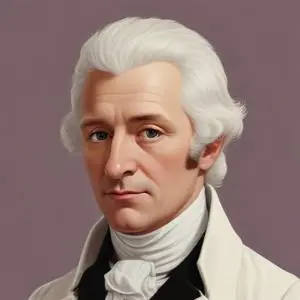
Founded the field of comparative anatomy, establishing extinction as a fact and creating a framework for understanding the natural world through fossil records.
Georges Cuvier, a French naturalist and zoologist, is renowned for establishing the fields of comparative anatomy and paleontology, and is often referred to as the "founding father of paleontology." His groundbreaking work in comparing living animals with fossils paved the way for a deeper understanding of the natural world and its history.
Born on August 23, 1769, in Montbéliard, France, Cuvier's fascination with the natural world began at a young age. He studied at the University of Stuttgart, where he developed a strong foundation in biology, chemistry, and physics. His academic excellence earned him a scholarship to the Academy of Natural Sciences in Paris, where he further honed his skills under the guidance of esteemed scientists.
Cuvier's most significant contribution to science was his development of comparative anatomy, which involved the study of similarities and differences between living organisms and fossils. Through his work, he established the principle of correlation of parts, which states that the structure of one body part is linked to the structure of another. This groundbreaking concept enabled him to reconstruct entire fossils from fragmentary remains.
His work in paleontology led to the discovery of many extinct species, including the mastodon and the giant ground sloth, Megatherium. He was also one of the first scientists to propose that the earth had been dominated by reptiles, rather than mammals, in prehistoric times.
Cuvier's research led him to propose that extinct species had been wiped out by periodic catastrophic flooding events. This theory, known as catastrophism, was a radical idea at the time, as many scientists believed that species could not become extinct. His Essay on the Theory of the Earth (1813) solidified his position as a leading proponent of catastrophism in geology.
Cuvier's work had a profound impact on the scientific community, and his contributions continue to influence the fields of paleontology, biology, and geology. He was elected as a foreign member of the Royal Swedish Academy of Sciences in 1817 and was awarded the Copley Medal in 1825 for his outstanding contributions to science.
"The destruction of an species is a fact, just as well founded as the existence of a species."
As the "father of paleontology," Georges Cuvier's contributions have left an indelible mark on our understanding of the natural world. His groundbreaking research, theories, and discoveries continue to inspire scientists and researchers today, cementing his place as one of the most influential scientists in history.
Born in 1744
A French soldier, biologist, and academic who developed a theory of inheritance of acquired characteristics, proposing that organisms adapt to their environment and pass on those traits to their offspring.
Born in 1809
Developed the theory of evolution through natural selection, revolutionizing our understanding of life on Earth. This groundbreaking idea transformed the fields of biology, ecology, and beyond.
Born in 1707
Developed the system of binomial nomenclature, which is still used today to classify and name living organisms. This system has had a profound impact on the fields of biology, ecology, and conservation.
Born in 1834
A German biologist, physician, and philosopher who coined the term "ecology" and made significant contributions to the field of evolutionary biology, including the recapitulation theory.
Born in 1804
A pioneering figure in the fields of biology, anatomy, and paleontology, known for coining the term "Dinosauria" and making significant contributions to our understanding of vertebrate evolution.
Born in 1749
Developed nebular hypothesis of the origin of the solar system and formulated Laplace's equation, a fundamental concept in mathematics and physics. He's considered the founder of celestial mechanics.
Born in 1743
Father of modern chemistry, discovered oxygen, and developed a systematic method of chemical nomenclature. He laid the foundation for modern chemistry and paved the way for future scientific discoveries.
Born in 1745
Italian physicist who invented the first electrical battery, revolutionizing the field of electricity and paving the way for countless technological advancements.
