


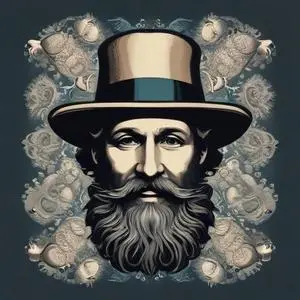
A German biologist, physician, and philosopher who coined the term "ecology" and made significant contributions to the field of evolutionary biology, including the recapitulation theory.
Ernst Haeckel, a German zoologist, naturalist, and philosopher, is renowned for his groundbreaking contributions to the fields of evolutionary biology, ecology, and art. He is particularly known for coining terms like "ecology," "phylum," and "Protista," and for his remarkable artwork that influenced the Art Nouveau movement.
Born on February 16, 1834, in Potsdam, Kingdom of Prussia, Haeckel pursued his passion for science and art from an early age. He completed his studies at the Domgymnasium in Merseburg in 1852, and later studied medicine in Berlin and Würzburg. His notable professors included Albert von Kölliker, Franz Leydig, and Rudolf Virchow, with whom he worked briefly as an assistant.
Haeckel's scientific contributions are multifaceted and far-reaching. He:
Haeckel's artistic talent is evident in his exquisite illustrations of animals and sea creatures. His book, Kunstformen der Natur (Art Forms of Nature), features over 100 detailed, multicolored illustrations that have inspired generations of artists, particularly those associated with the Art Nouveau movement.
As a philosopher, Haeckel wrote extensively on the nature of reality and human existence. His book, Die Welträtsel (The Riddle of the Universe), explores the mysteries of the universe and our place within it.
Haeckel was also a vocal advocate for scientific freedom and the importance of evolution in education. His work, Freiheit in der Wissenschaft und Lehre (Freedom in Science and Teaching), championed the cause of evolutionary theory in the face of opposition.
Haeckel's contributions have had a profound impact on modern society. His work has:
Haeckel's legacy is not without controversy. He was a proponent of scientific racism and Social Darwinism, ideologies that have been widely criticized and discredited.
Despite these criticisms, Haeckel's contributions to science, art, and philosophy remain unparalleled. His work continues to inspire and educate, offering a fascinating glimpse into the intricacies of the natural world and the human experience.
Born in 1809
Developed the theory of evolution through natural selection, revolutionizing our understanding of life on Earth. This groundbreaking idea transformed the fields of biology, ecology, and beyond.
Born in 1822
An Austrian monk who pioneered genetics by experimenting with pea plants, discovering the fundamental laws of heredity, and laying the foundation for modern genetics.
Born in 1744
A French soldier, biologist, and academic who developed a theory of inheritance of acquired characteristics, proposing that organisms adapt to their environment and pass on those traits to their offspring.
Born in 1823
A pioneering naturalist who discovered evolution through natural selection, independently of Charles Darwin, and contributed significantly to the field of biogeography.
Born in 1804
A pioneering figure in the fields of biology, anatomy, and paleontology, known for coining the term "Dinosauria" and making significant contributions to our understanding of vertebrate evolution.
Born in 1825
A prominent figure in the scientific community, known for advocating Charles Darwin's theory of evolution and coining the term "agnostic" to describe his own religious views.
Born in 1814
Union general who played a crucial role in the American Civil War, particularly at the Battle of Chancellorsville and Gettysburg.
Born in 1810
A pioneering botanist who contributed significantly to the development of American botany, particularly in the fields of plant classification and evolution.
