


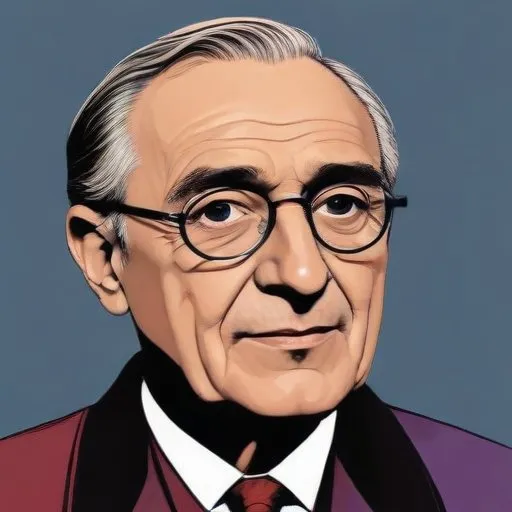
A French biologist and geneticist who discovered the mechanism of gene regulation, pioneering the field of molecular biology. He won the Nobel Prize in Physiology or Medicine in 1965 for his work on the genetic control of enzyme synthesis.
Franois Jacob is renowned for originating the groundbreaking idea, along with Jacques Monod, that control of enzyme levels in all cells occurs through regulation of transcription. This pioneering work earned him the 1965 Nobel Prize in Medicine, which he shared with Monod and Andr Lwoff.
Born on June 17, 1920, in Nancy, France, Jacob was the only child of Simon, a merchant, and Thrse Franck Jacob. His inquisitive nature led him to learn to read at a young age, and he was heavily influenced by his maternal grandfather, Albert Franck, a four-star general.
Jacob's education took place at the Lyce Carnot, where he spent the next ten years of his life. He has described this period as being confined to a "cage." He was antagonized by rightist youth at the Lyce Carnot around 1934 and later became an atheist after his bar mitzvah.
Initially interested in physics and mathematics, Jacob was deterred by the prospect of spending additional years in a rigid educational system to pursue higher studies at the Polytechnique. Instead, he entered medical school, where he became fascinated by a surgical operation that sparked his interest in medicine.
During the German occupation of France, Jacob left for Great Britain to join the war effort. He joined the medical company of the French 2nd Armored Division in 1940 and was injured in a German air attack in 1944. After his recovery, he returned to medical school and began researching tyrothricin, learning the methods of bacteriology.
Jacob's pioneering work with Jacques Monod led to the discovery of the lac operon, a genetic system that regulates gene expression in response to environmental changes. This groundbreaking research revealed the mechanism of genetic regulation, revolutionizing our understanding of gene expression and molecular biology.
The significance of their discovery was recognized globally, and Jacob, along with Monod and Lwoff, was awarded the 1965 Nobel Prize in Medicine "for their discoveries concerning genetic control of enzyme and virus synthesis."
Jacob's work has had a profound impact on modern molecular biology, influencing our understanding of gene regulation, cellular differentiation, and developmental biology. His discovery has paved the way for significant advances in fields such as genetic engineering, biotechnology, and medicine.
Beyond his scientific contributions, Jacob's legacy extends to his influence on modern society. His work has inspired generations of scientists, and his discovery has led to the development of novel therapeutic strategies and treatments for various diseases.
"The aim of science is not to seek consolation, but to understand."
Franois Jacob's pioneering work and groundbreaking discovery have left an indelible mark on the field of molecular biology. His legacy continues to inspire and influence scientists, ensuring that his impact will be felt for generations to come.
Born in 1910
A French biochemist and geneticist who discovered the mechanism of gene regulation, earning a Nobel Prize in Physiology or Medicine in 1965. He's also known for his book "Chance and Necessity," which explores the philosophical implications of modern biology.
93 Years Old
A French physicist who pioneered the study of soft matter and polymers, earning a Nobel Prize in Physics in 1991 for his work on liquid crystals.
90 Years Old
A renowned neuroscientist and biologist who pioneered the understanding of the neural basis of consciousness and the development of the nicotinic acetylcholine receptor. He has made significant contributions to the fields of neuroscience, biology, and philosophy.
Born in 1924
A pioneering endocrinologist who discovered the hormone gastrin and its role in the digestive system, leading to significant advances in understanding hormonal regulation.
Born in 1902
Pioneering geneticist who discovered transposons, mobile genetic elements that jump from one location to another in a genome, revolutionizing our understanding of genetic variation and evolution.
