


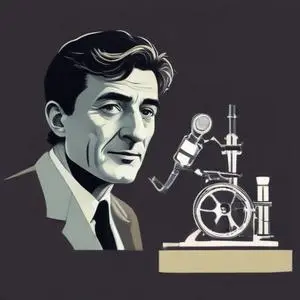
A French biochemist and geneticist who discovered the mechanism of gene regulation, earning a Nobel Prize in Physiology or Medicine in 1965. He's also known for his book "Chance and Necessity," which explores the philosophical implications of modern biology.
Jacques Monod, a French biochemist, revolutionized the understanding of genetic control by discovering the mechanisms that govern enzyme and virus synthesis, earning him the Nobel Prize in Physiology or Medicine in 1965. His groundbreaking work on the E. coli lac operon, alongside François Jacob and André Lwoff, shed light on the intricate processes that regulate gene expression.
Born on February 9, 1910, in Paris, France, Monod's interest in science was sparked during his early years. He pursued higher education at the Sorbonne, where he encountered a curriculum that was decades behind the current biological sciences. Undeterred, Monod sought knowledge from his peers, learning from students slightly older than himself. This unorthodox approach led him to discover the works of prominent scientists, including George Teissier, André Lwoff, Boris Ephrussi, and Louis Rapkine.
Monod's fascination with microbiology and physiological genetics paved the way for his influential research. He explored the lac operon, a genetic system that regulates the breakdown of lactose in Escherichia coli. His work, in collaboration with François Jacob, led to the discovery of the repressor protein, which binds to specific DNA sequences to control gene expression. This pioneering finding introduced the concept of transcriptional regulation, establishing Monod as one of the founders of molecular biology.
Monod's work extended beyond the scientific realm, as he explored the philosophical implications of his discoveries. In his book, "Chance and Necessity," he debated the role of chance and necessity in the evolution of life. Monod's ideas continue to influence the ongoing discussion on the intersection of science, philosophy, and ethics.
Monod's contributions to molecular biology have had a profound impact on modern medicine, agriculture, and biotechnology. His work on gene regulation has enabled the development of novel therapeutics, genetically modified crops, and innovative biotechnological applications. As a result, Monod's discoveries have improved human lives and transformed industries worldwide.
Jacques Monod's groundbreaking research has left an indelible mark on the scientific community. His work has inspired generations of scientists, and his legacy continues to shape our understanding of the intricate mechanisms that govern life. As a pioneer in molecular biology, Monod's contributions will forever be etched in the annals of scientific history.
Born in 1920
A French biologist and geneticist who discovered the mechanism of gene regulation, pioneering the field of molecular biology. He won the Nobel Prize in Physiology or Medicine in 1965 for his work on the genetic control of enzyme synthesis.
Born in 1913
A French novelist, philosopher, and journalist who wrote influential works like "The Stranger" and "The Plague", exploring absurdism and the human condition.
Born in 1905
Existentialist philosopher and playwright who argued that humans have complete freedom to choose their actions and create their own meaning in life, influencing modern thought on morality and individual responsibility.
Born in 1908
A pioneering feminist philosopher who wrote extensively on ethics, politics, and gender, famously arguing that "one is not born, but rather becomes, a woman."
Born in 1908
A French philosopher and academic who developed the concept of phenomenology, exploring the relationship between the self and the world, and is known for his work on perception, consciousness, and embodiment.
Born in 1859
A French philosopher and Nobel laureate who developed the concept of "duration" and emphasized the importance of intuition and experience in understanding reality. He's known for his philosophical ideas on time, consciousness, and the human experience.
Born in 1858
A founder of modern sociology, known for establishing the field and exploring the relationships between individuals and society, particularly in his work "Suicide".
Born in 1859
A pioneer in radioactivity research, discovering elements like polonium and radium, and pioneering radioactive isolation techniques. Their groundbreaking work paved the way for advancements in medicine, energy, and materials science.
