


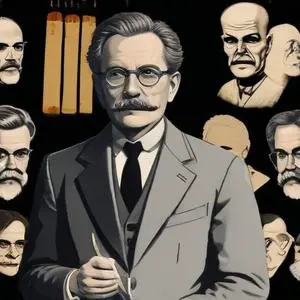
Pioneering anthropologist and linguist who challenged prevailing racial and cultural stereotypes, establishing modern anthropology and contributing significantly to our understanding of human diversity and cultural relativity.
Franz Boas is renowned as the pioneer of modern anthropology, earning the title "Father of American Anthropology" for his groundbreaking work in the field. His holistic approach to understanding human cultures, languages, and societies continues to influence anthropological studies to this day.
Born on July 9, 1858, in Minden, Germany, Boas was drawn to the sciences from an early age. He pursued a degree in physics from the University of Kiel, graduating in 1881. His fascination with geography led him to participate in a geographical expedition to northern Canada, where he encountered the Inuit people and became captivated by their culture and language.
Boas's work in the Pacific Northwest with indigenous cultures and languages solidified his reputation as a pioneering anthropologist. In 1887, he emigrated to the United States, where he became a museum curator at the Smithsonian Institution. Later, in 1899, he took on the role of professor of anthropology at Columbia University, a position he held until the end of his career.
Through his students, many of whom went on to found anthropology departments and research programs, Boas profoundly influenced the development of American anthropology. His notable students include A. L. Kroeber, Alexander Goldenweiser, Ruth Benedict, Edward Sapir, Margaret Mead, Zora Neale Hurston, and Gilberto Freyre.
Boas was a staunch opponent of scientific racism, which posited that race is a biological concept and that human behavior is best understood through the typology of biological characteristics. He challenged this ideology through a series of groundbreaking studies on skeletal anatomy, demonstrating that cranial shape and size are highly malleable depending on environmental factors such as health and nutrition.
Boas's work emphasized the significance of cultural differences acquired through social learning, rather than innate biological dispositions. This approach paved the way for a more nuanced understanding of human behavior and cultural diversity.
Boas's contributions to anthropology have had a lasting impact on modern society. His emphasis on cultural relativism and historical particularism continues to shape anthropological research and its applications in fields such as sociology, psychology, and cultural studies.
Some of his notable works include The Central Eskimo (1888), The Mind of Primitive Man (1911), and Race, Language and Culture (1940). These works showcase his dedication to understanding human cultures and challenging prevailing racist ideologies.
Franz Boas's remarkable life and work have left an indelible mark on the field of anthropology. His commitment to cultural understanding, his opposition to scientific racism, and his influence on modern anthropology continue to inspire new generations of researchers and scholars.
Born in 1901
A pioneering anthropologist and author who studied and wrote about diverse cultures, shedding light on human behavior and societal norms. Her groundbreaking work continues to influence modern anthropology and beyond.
Born in 1876
Pioneering anthropologist and ethnologist who explored the intersection of culture and psychology, shedding light on the complexities of human societies and behaviors.
Born in 1891
A celebrated author and anthropologist who explored African-American culture through novels, stories, and folklore, particularly in the rural South during the early 20th century.
75 Years Old
A Polish athlete who won Olympic medals in the 400 meters hurdles and 4x400 meters relay at the 1964 Tokyo Olympics, setting multiple national records.
Born in 1872
A pioneering sociologist and anthropologist who developed the concept of "gift economy" and explored the social significance of exchange and reciprocity in human societies.
Born in 1908
A founder of modern anthropology, known for structuralism and deciphering the underlying patterns of human culture and society. His work bridges the gap between sociology, psychology, and philosophy.
