


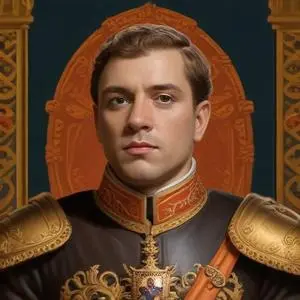
Led the Dutch Republic to greatness during the Eighty Years' War, capturing key cities and fortifications, and earning the nickname "Stadtholder of Holland, Zeeland, Utrecht, Guelders, and Overijssel". He's also known for his military genius and strategic thinking.
Frederick Henry, Prince of Orange, is renowned for his military prowess and strategic brilliance, earning him the epithet "City Forcer" (Dutch: stedendwinger) for his successful sieges of fortified cities during the Dutch Wars against Spain. His most notable achievement was the capture of 's-Hertogenbosch in 1629, a well-fortified city and main Spanish base, which significantly shifted the balance of power in favor of the Dutch Republic.
Born on January 29, 1584, in Delft, Holland, Frederick Henry was the youngest child of William the Silent and Louise de Coligny. His father, William, was the stadtholder of Holland, Zeeland, Utrecht, and Friesland, while his mother, Louise, was the daughter of the Huguenot leader Gaspard de Coligny.
Frederick Henry was trained in arms by his elder brother, Maurice of Orange, one of the finest generals of his age. Before his marriage, he had an illegitimate son, Frederick Nassau de Zuylestein, with Margaretha Catharina Bruyns in 1624. He later married his first cousin once removed, Amalia of Solms-Braunfels, in 1625.
After Maurice's death in 1625 without legitimate issue, Frederick Henry became the stadtholder of Holland, Zeeland, Utrecht, Guelders, and Overijssel. He went on to expand his territories, capturing the strategic city of 's-Hertogenbosch in 1629, which was a significant victory against the Spanish.
His military campaigns were marked by innovative strategies, including the successful neutralization of the threat of inundation of the area around 's-Hertogenbosch and the capture of the Spanish storehouse at Wesel. These victories solidified his reputation as a skilled military leader and earned him the respect of his contemporaries.
Frederick Henry's military achievements and strategic brilliance had a lasting impact on the Dutch Republic, securing its independence from Spanish rule. His legacy extends beyond the battlefield, as he played a crucial role in shaping the modern Dutch state and its politics.
Today, he is remembered as a national hero in the Netherlands, with his name and likeness appearing on various monuments, coins, and stamps. His life and achievements serve as an inspiration to future generations, demonstrating the importance of strategic thinking, military prowess, and strong leadership.
Born in 1547
A Dutch statesman who played a crucial role in the Dutch Revolt against Spanish rule, leading to the formation of the Dutch Republic. He's known for his diplomatic and strategic skills in unifying the Dutch provinces.
Born in 1533
The Virgin Queen, a powerful and beloved monarch, ruled England during a golden age of culture, literature, and exploration, establishing the Church of England and defeating the Spanish Armada.
