


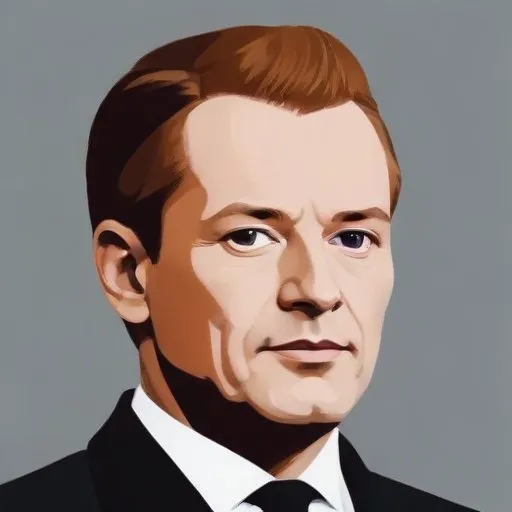
A Dutch statesman who played a crucial role in the Dutch Revolt against Spanish rule, leading to the formation of the Dutch Republic. He's known for his diplomatic and strategic skills in unifying the Dutch provinces.
Johan van Oldenbarnevelt is revered as one of the most influential figures in Dutch history, renowned for his instrumental role in the country's struggle for independence from Spain. As a statesman, revolutionary, and founder of the Dutch East India Company, Van Oldenbarnevelt's legacy has left an indelible mark on the Netherlands.
Born on September 14, 1547, in Amersfoort, Netherlands, Van Oldenbarnevelt pursued higher education in law at prestigious universities in Leuven, Bourges, Heidelberg, and Padua. His travels in France and Italy broadened his perspective, preparing him for a life of public service.
Van Oldenbarnevelt's early political career was marked by his support for William the Silent in his revolt against Philip II of Spain. He fought in William's army and later became a strong advocate for the Arminians during the religious-political controversy that divided the young Dutch Republic.
In 1602, Van Oldenbarnevelt founded the Dutch East India Company, a venture that would cement the Netherlands' position as a major trading power. This pioneering effort not only brought immense wealth to the country but also facilitated the growth of its colonial empire.
Van Oldenbarnevelt's industry, strategic thinking, and eloquence earned him a position of influence in the States of Holland. He played a key role in promoting the Union of Utrecht (1579) and the offer of the countship of Holland and Zeeland to William the Silent. After William's death in 1584, Van Oldenbarnevelt continued to support Maurice of Nassau, a son of William, and opposed the policies of the Earl of Leicester, the governor-general at the time.
Van Oldenbarnevelt's towering legacy in Dutch history is a testament to his unwavering commitment to the country's independence and prosperity. His contributions to the establishment of the Dutch East India Company, his role in shaping the Netherlands' early politics, and his tireless efforts to promote national unity have secured his place among the nation's most revered figures.
Despite his numerous achievements, Van Oldenbarnevelt's later years were marked by controversy. His support for the Arminians led to criticism from some quarters, and his eventual execution in 1619, at the age of 71, remains a topic of debate among historians.
Van Oldenbarnevelt's influence extends far beyond his own lifetime. His role in shaping the Dutch East India Company's early success paved the way for the Netherlands' emergence as a global trading power. His legacy continues to inspire generations of Dutch politicians, economists, and business leaders.
Born in 1583
A 17th-century philosopher and jurist who laid the foundations for modern international law, particularly the concept of "just war" and the laws of the sea.
Born in 1574
An English explorer and cartographer who mapped the New World and created innovative navigational tools, contributing significantly to the development of modern cartography.
Born in 1519
King of France from 1547 to 1559, known for his cultural and artistic patronage, and his role in the Italian Wars.
