


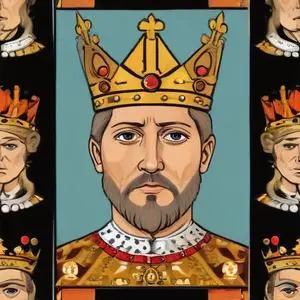
Ruling the Holy Roman Empire from 1220 to 1250, he was a powerful and cultured leader who promoted arts, science, and architecture, and was known for his impressive constructions, including the Castel del Monte.
Frederick II, also known as Stupor Mundi or the "Wonder of the World," was a remarkable figure in history, renowned for his vast conquests, cultural achievements, and intellectual pursuits. As the King of Sicily, King of Germany, King of Italy, and Holy Roman Emperor, he left an indelible mark on the medieval world.
Born on December 26, 1194, Frederick II was the son of Emperor Henry VI of the Hohenstaufen dynasty and Queen Constance of Sicily of the Hauteville dynasty. At the tender age of three, he was crowned King of Sicily as a co-ruler with his mother, setting the stage for his future reigns.
Frederick II's ambition and military prowess led him to expand his dominions, conquering territories that stretched from Sicily to Germany, Italy, and even Jerusalem. His crowning achievement was being crowned Holy Roman Emperor in 1220, solidifying his position as a powerful ruler of the medieval world.
Frederick II was a true Renaissance man, fluent in six languages: Latin, Sicilian, Middle High German, Old French, Greek, and Arabic. He was a patron of science, literature, and the arts, fostering the Sicilian School of poetry and supporting scholars, architects, and composers. His court in Palermo became a beacon of cultural excellence, attracting intellectuals and artists from across Europe.
Frederick II's legacy extends beyond the medieval period, shaping the development of modern society in various ways. His promotion of science, literature, and the arts helped lay the groundwork for the Renaissance and the Enlightenment. His architectural innovations, such as the construction of the Castel del Monte, continue to inspire architectural design.
Frederick II's worldview was influenced by Aristotle, and he was fascinated by the natural world, astronomy, and mathematics. He wrote treatises on falconry and zoology, demonstrating his curiosity about the natural sciences. His philosophical leanings were shaped by his encounters with Islamic scholars during the Crusades.
Frederick II's tumultuous relationships with the Papacy, multiple excommunications, and his reputation as a skilled military commander often led to controversy and vilification in propapal chronicles. Pope Gregory IX even declared him the "predecessor of the Antichrist."
Frederick II's philosophical outlook was reflected in his saying, "Man is a universe in miniature." This quote showcases his fascination with the natural world and his understanding of humanity's place within it.
Frederick II's reign marked a turning point in medieval history, bridging the gap between the Crusades and the Renaissance. His cultural achievements, conquests, and intellectual pursuits continue to inspire awe and fascination, solidifying his position as one of the most influential figures of the Middle Ages.
Born in 1710
The monarch who ruled France from 1715 to 1774, known as the "Sun King's" great-grandson, and remembered for his extravagance, absolutism, and the decline of the French monarchy.
Born in 1769
A French military leader who rose to prominence during the French Revolution and became Emperor of France, known for his military conquests and reorganization of Europe. He is also famous for his Napoleonic Code, which remains a foundation of modern law.
Born in 1879
A brilliant physicist who developed the theory of relativity and is considered one of the most influential scientists of the 20th century, known for his groundbreaking work in physics and mathematics.
Born in 1564
Pioneering astronomer, physicist, and mathematician who played a major role in the Scientific Revolution, making key discoveries that challenged Aristotelian views and laid the foundation for modern science.
Born in 1452
Renaissance mastermind behind iconic works like the Mona Lisa and The Last Supper, who revolutionized art, science, and engineering with his inventive and curious nature.
Born in 1483
A German monk and priest who sparked the Protestant Reformation, challenging Catholic Church authority and shaping Western Christianity. He's famous for nailing 95 theses to a church door, sparking a religious revolution.
