


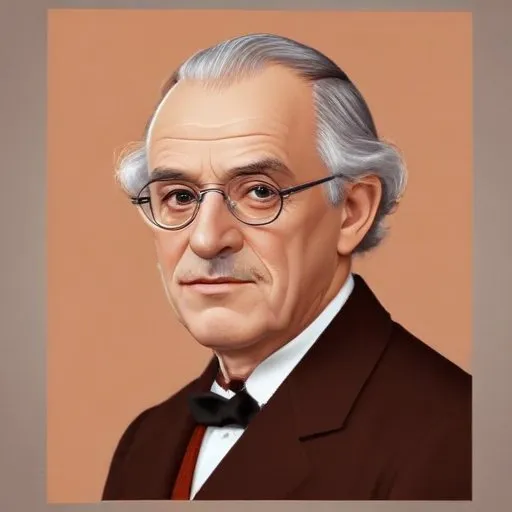
A pioneering chemist who discovered the elements protactinium and radium, and was awarded the Nobel Prize in Chemistry in 1921 for his work on radioactive substances.
Frederick Soddy, a pioneering English radiochemist, revolutionized the understanding of radioactivity, illuminating the mysteries of atomic transmutation and isotopes. In 1921, his groundbreaking contributions earned him the Nobel Prize in Chemistry, solidifying his position as a trailblazer in the field.
Born on September 2, 1877, in Eastbourne, England, Soddy was the son of Benjamin Soddy, a corn merchant, and Hannah Green. He pursued his education at Eastbourne College, followed by University College of Wales at Aberystwyth, and ultimately at Merton College, Oxford, where he graduated with first-class honors in chemistry in 1898.
In 1900, Soddy joined McGill University in Montreal, Quebec, as a demonstrator in chemistry, where he collaborated with the renowned Ernest Rutherford. Together, they unraveled the enigmatic behavior of radioactive elements, attributing it to atomic transmutation, which produces alpha, beta, and gamma radiation.
In a groundbreaking experiment with Sir William Ramsay at University College London, Soddy demonstrated that the decay of radium produces helium gas in 1903. This pioneering work laid the foundation for subsequent research, including Rutherford and Thomas Royds' 1907 discovery that alpha particles are helium nuclei.
Soddy's intellectual curiosity and adaptability led him to excel in various fields beyond radiochemistry. He made significant contributions to nuclear physics, statistical mechanics, finance, and economics, earning him the reputation as a polymath.
Soddy's Nobel Prize in Chemistry in 1921 marked a pinnacle in his career, recognizing his tireless efforts to elucidate the chemistry of radioactive substances and his investigations into the origin and nature of isotopes.
Soddy's pioneering work has far-reaching implications, influencing modern nuclear physics, medicine, and environmental science. His research has inspired generations of scientists, fostering a deeper understanding of the atomic structure and its applications.
Frederick Soddy's remarkable journey has left an indelible mark on the scientific community, illuminating the mysteries of radioactivity and inspiring future generations of scientists and thinkers.
Born in 1871
A pioneer in nuclear physics, he discovered the nucleus of an atom and developed the Rutherford model, revolutionizing our understanding of the atomic structure.
Born in 1885
A pioneer in quantum mechanics, he introduced the concept of wave-particle duality, revolutionizing our understanding of atomic structure. His philosophical approach to science also explored the nature of reality and human understanding.
Born in 1867
A pioneering scientist who pioneered radioactivity research, discovering elements polonium and radium, and paving the way for breakthroughs in medicine and energy.
Born in 1879
A brilliant physicist who developed the theory of relativity and is considered one of the most influential scientists of the 20th century, known for his groundbreaking work in physics and mathematics.
Born in 1856
Discovered the electron and developed the plum pudding model of the atom, revolutionizing our understanding of atomic structure.
Born in 1858
A pioneer in quantum theory, he introduced the concept of the Planck constant, revolutionizing our understanding of energy and matter.
Born in 1901
A pioneer in quantum mechanics, he formulated the uncertainty principle, which revolutionized our understanding of the atomic world. His groundbreaking work reshaped modern physics.
