


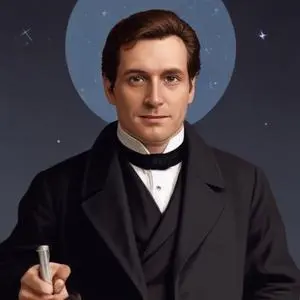
Developed the Bessel functions, a set of mathematical equations crucial for astronomy, navigation, and engineering, and made the first accurate measurement of a star's distance from Earth.
Friedrich Bessel, a German astronomer, is renowned for being the first to measure the distance to a star other than the Sun, earning him the title of the "Father of Astrometry."
Bessel's groundbreaking work in the field of astronomy led to a plethora of contributions, including the development of a new method for determining the position of celestial objects, known as the "Besselian method."
Born on July 22, 1784, in Minden, Westphalia, Prussia (now Germany), Bessel grew up in a family of modest means. Despite the financial constraints, his parents recognized his intellectual aptitude and encouraged his pursuit of knowledge.
Bessel's interest in astronomy was sparked at a young age, and he began his education in astronomy at the age of 18. He later moved to Lilienthal, where he worked as an accountant for a shipping company.
Bessel's career as an astronomer took off in 1806 when he became the assistant to astronomer Johann Hieronymus Schröter. This opportunity allowed him to hone his skills and eventually led to his appointment as the director of the Königsberg Observatory in 1813.
During his tenure at the observatory, Bessel made significant contributions to the field of astronomy, including:
Bessel's pioneering work in astrometry paved the way for further advancements in astronomy, influencing the development of modern astrophysics and cosmology. His contributions also enabled the calculation of distances to celestial objects, allowing for a deeper understanding of the universe.
Today, Bessel's legacy extends beyond the realm of astronomy, inspiring future generations of scientists and researchers to push the boundaries of human knowledge.
Bessel's personal life was marked by tragedy, including the loss of his first wife, Johanna, in 1837. He later married his second wife, Adalbertine, and had two children with her.
Throughout his life, Bessel was recognized for his achievements, receiving numerous honors and awards, including the Gold Medal of the Royal Astronomical Society in 1829 and the Copley Medal in 1841.
Bessel's work took place during a time of significant scientific discovery, with the Industrial Revolution spawning a new era of technological advancements. His contributions to astronomy were instrumental in shaping our understanding of the universe, laying the groundwork for future scientific breakthroughs.
As a testament to his legacy, the Bessel crater on the Moon and the asteroid 1552 Bessel are named in his honor. His work continues to inspire and influence astronomers, physicists, and scientists around the world.
Friedrich Bessel's remarkable life and achievements serve as a testament to the power of human curiosity and the pursuit of knowledge. His legacy continues to inspire and influence generations of scientists, ensuring that his impact on astronomy and beyond will be felt for centuries to come.
Born in 1777
A pioneer in mathematics and physics, he made major contributions to number theory, algebra, and electromagnetism, shaping our understanding of the natural world.
Born in 1749
Developed nebular hypothesis of the origin of the solar system and formulated Laplace's equation, a fundamental concept in mathematics and physics. He's considered the founder of celestial mechanics.
Born in 1752
Developed the theory of elliptic integrals, and his work on number theory laid the foundation for modern cryptography.
Born in 1774
A French polymath who made significant contributions to the fields of physics, astronomy, and mathematics, particularly in the discovery of chromatic polarization and the Biot-Savart law.
Born in 1811
Predicted the existence and location of Neptune, a previously unknown planet, through mathematical calculations, revolutionizing astronomy.
