


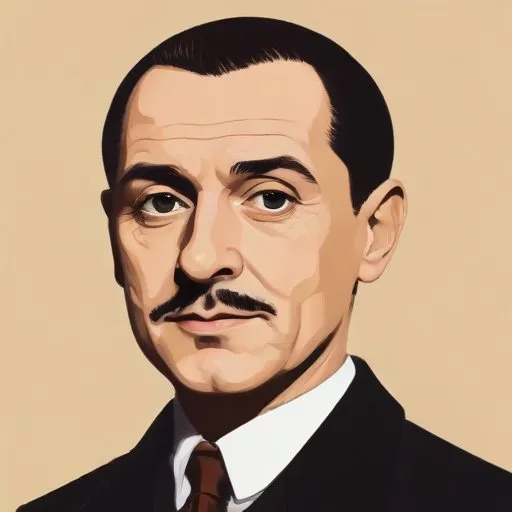
Austrian-German actor and director renowned for his intense, expressive performances on stage and screen, particularly in German Expressionist cinema. He also directed several films and plays, showcasing his versatility in the performing arts.
Fritz Kortner, born Fritz Nathan Kohn, was an Austrian stage and film actor and theatre director renowned for his explosive energy on stage and powerful voice, earning him the reputation as one of Germany's best-known character actors and the nation's foremost performer of Expressionist works.
Kortner was born on May 12, 1892, in Vienna, Austria, to a Jewish family. He studied at the Vienna Academy of Music and Dramatic Art, where he honed his craft and developed a passion for the performing arts.
Kortner's breakthrough performance in Ernst Tollers' Transfiguration in 1919 catapulted him to stardom, and he went on to appear in over 90 films starting from 1916. His specialty lay in playing sinister and threatening roles, although he also excelled in playing the title role in Dreyfus (1930).
Kortner's work began to incorporate greater realism as the 1920s progressed, marked by a shift towards a more controlled delivery and greater use of gestures. This innovative approach earned him recognition as a master of his craft.
With the rise of the Nazi regime in 1933, Kortner fled Germany with his wife, actress Johanna Hofer, and eventually settled in the United States in 1937. There, he established himself as a respected character actor and theatre director, working with leading Playwrights and actors of the time.
Kortner returned to Germany in 1949, where he continued to innovate and push the boundaries of theatre. He was particularly noted for his innovative staging and direction of classics by William Shakespeare and Molière, such as his 1964 production of Richard III, which featured the king crawling over piles of corpses in the finale.
Kortner's contributions to the world of theatre were recognized with numerous awards and honors, solidifying his position as one of the most respected and celebrated actors and directors of his time.
Kortner penned two autobiographies, Letzten Endes. Fragmente. (1971) and Aller Tage Abend. Autobiographie. (1996), offering a candid insight into his life, career, and artistic vision.
Fritz Kortner passed away on July 22, 1970, at the age of 78, leaving behind a rich legacy in the world of theatre and film. His innovative approach, powerful performances, and trailblazing spirit continue to inspire generations of actors, directors, and artists.
Born in 1901
A glamorous and androgynous Hollywood icon, known for her sultry voice, striking features, and trailblazing gender-bending style on screen. She mesmerized audiences with her unique blend of European sophistication and American charm.
Born in 1905
A legendary actress who captivated audiences with her iconic performances on the silver screen, earning her the title of Hollywood's first female superstar.
Born in 1899
Iconic leading man of classic Hollywood cinema, starring in timeless films like Casablanca and The African Queen, embodying a tough, charismatic on-screen presence.
Born in 1915
A legendary actress who captivated audiences with her natural, emotional performances in films like "Casablanca" and "Autumn Sonata", earning her three Academy Awards.
Born in 1908
A legendary actress who dominated Hollywood's Golden Age with her powerful performances and iconic roles in films like "All About Eve" and "What Ever Happened to Baby Jane?"
Born in 1892
A pioneering filmmaker who charmed audiences with sophisticated comedies and witty romantic dramas, often blending satire and social commentary.
Born in 1888
A pioneering filmmaker who crafted hauntingly beautiful and influential silent movies, including the iconic vampire classic "Nosferatu".
Born in 1873
Pioneering director who revolutionized theater and film with innovative productions, introducing expressionism and avant-garde styles to the masses.
