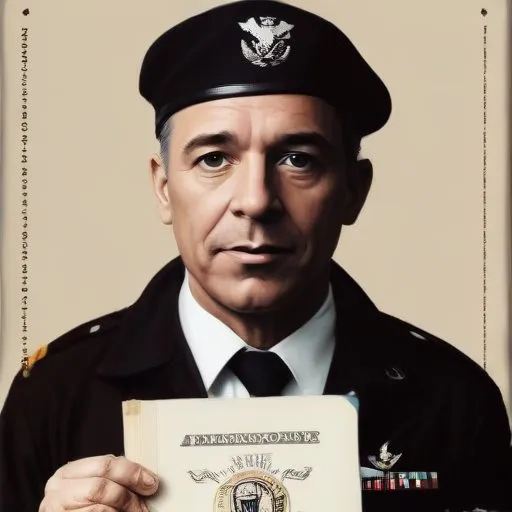
Garry Davis: The Maverick Advocate for World Government
The Revolutionary Who Renounced Nationality
Garry Davis is best known for his bold act of renouncing his American citizenship in 1948, taking the world by storm as he championed the cause of a unified world government. This provocative move sparked international attention, earning him both admiration and ridicule from intellectuals, politicians, and the general public.
Early Life and Career
Born on July 27, 1921, in Bar Harbor, Maine, Davis was the son of a Jewish father, Meyer, and an Irish mother, Hilda. He graduated from The Episcopal Academy in 1940 and later attended the Carnegie Institute of Technology (now Carnegie Mellon University). Before devoting himself to the pursuit of world government, Davis had a successful career as a Broadway stage actor, serving as an understudy for
Danny Kaye and performing in hits like "Let's Face It" and "Three to Get Ready."
World War II and the Turning Point
Davis's life took a dramatic turn during World War II, where he served as a B-17 bomber pilot in the U.S. Army. The loss of his brother in combat and the devastating consequences of his own bombings, including the destruction of the city of Brandenburg, deeply affected him. This experience ignited his passion for world government, as he became convinced that nationalistic wars were the root of humanity's suffering and that a unified global entity was the only way to prevent future catastrophes.
The World Government Crusade
In 1948, Davis took the unprecedented step of renouncing his U.S. citizenship, declaring himself a "citizen of the world." This act was not only a personal statement but also a call to action, as he sought to awaken humanity to the need for a unified world government. Davis's advocacy resonated with intellectuals like
Albert Camus and
Albert Einstein, who publicly supported his cause.
The World Service Authority and the World Passport
In 1953, Davis founded the nonprofit World Service Authority, an organization dedicated to educating and promoting the concept of world government. One of the Authority's most notable initiatives is the issuance of the World Passport, a document grounded in Davis's interpretation of Article 13 of the Universal Declaration of Human Rights and the concept of world citizenship. Although the passport is not recognized by any government, it has been used by thousands of individuals as a symbol of their commitment to global unity.
Legacy and Impact
Garry Davis's unwavering dedication to the cause of world government has inspired countless individuals and organizations. His courage in challenging the status quo and his unrelenting pursuit of a unified humanity have made him a pioneer in the quest for global cooperation and peace. As a testament to his legacy, the World Service Authority continues to operate, promoting Davis's vision of a world where national borders are transcended and humanity is united under a single, harmonious government.
Quotes and Memorable Sayings
- "The only way to end war is to eliminate the cause of war, and the cause of war is the nation-state."
- "I do not recognize the boundaries of any nation-state, for I am a citizen of the world."
Personal Milestones and Key Life Events
- 1940: Graduated from The Episcopal Academy
- 1948: Renounced U.S. citizenship, declaring himself a "citizen of the world"
- 1953: Founded the World Service Authority
- 2013: Passed away on July 24, at the age of 91
Influence on Modern Society
Garry Davis's advocacy for world government has contributed significantly to the global debate on international cooperation, inspiring numerous organizations and initiatives focused on promoting global unity and peace. His legacy serves as a powerful reminder of the importance of rethinking traditional notions of nationhood and working towards a more harmonious, interconnected world.
FAQ
What was Garry Davis most notable achievement in global citizenship?
Garry Davis, an American pilot and activist, created the World Passport, a document that recognizes individuals as global citizens rather than nationals of a particular country.
What was the inspiration behind Garry Davis World Passport?
Garry Davis was inspired to create the World Passport after the devastating effects of World War II, believing that national borders were a main cause of conflict and that global citizenship could bring about world peace.
How many countries recognized the World Passport?
Over 180 countries and international organizations have recognized the World Passport, although its acceptance varies by nation.
What were Garry Davis other notable accomplishments?
Garry Davis was a pilot in World War II and later became an international delegate, attending UN conferences and advocating for global citizenship.
How did Garry Davis pass away?
Garry Davis passed away on July 24, 2013, at the age of 91, in Washington, D.C.