


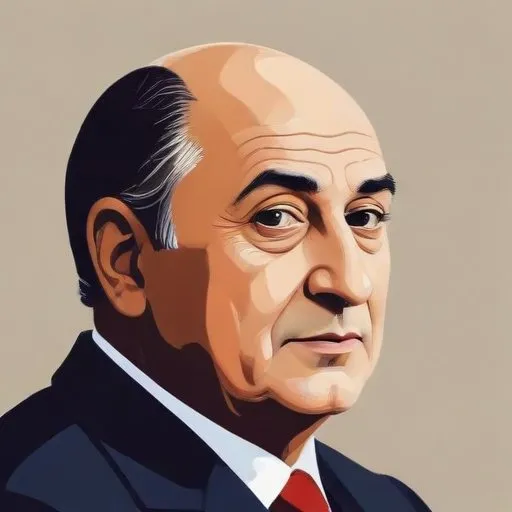
A Georgian prince who served as a diplomat and politician, playing a key role in the country's struggle for independence from Russia. He's most known for his efforts to modernize and Westernize Georgia.
Garsevan Chavchavadze is remembered as a prominent Georgian nobleman, politician, and diplomat who played a pivotal role in shaping the course of Georgian history. He is best known for serving as the Georgian ambassador to Imperial Russia, fostering diplomatic relations between the two nations, and advocating for Georgia's sovereignty and protection under Russian patronage.
Prince Garsevan Chavchavadze was born on July 20, 1757, into a noble family of the 3rd rank from the kingdom of Kakheti, eastern Georgia. He hailed from a long line of distinguished Georgians, and his family's influence and reputation paved the way for his future endeavors.
Prince Chavchavadze began his diplomatic career as an adjutant-general to Heraclius II of Georgia, king of Kartli and Kakheti. He was instrumental in the negotiations that led to the 1783 Treaty of Georgievsk with Russia, which placed the Georgian kingdom under the protection of Tsarina Catherine II. This significant agreement marked a turning point in Georgian-Russian relations.
In 1784, Prince Chavchavadze was appointed as the Georgian ambassador to St. Petersburg, where he was warmly received by the Russian aristocracy. Empress Catherine II even became a godmother to his son, Alexander, who would later become a renowned poet and general. During his tenure as ambassador, Prince Chavchavadze worked tirelessly to ensure that Russia fulfilled its promise of protection to Georgia.
In 1795, Persia attacked and devastated Georgia, despite Erekli's refusal to sever ties with Russia. The Russian government failed to provide adequate assistance, leaving Georgia vulnerable and disappointed. Prince Chavchavadze's faith in the Russian alliance began to waver, but he continued to advocate for Georgia's interests.
Upon the death of George XII of Georgia in 1800, Russia declared its annexation of Georgia, effectively abolishing the Bagrationi dynasty. Prince Chavchavadze was devastated by this decision, writing to his relatives that "the Russians have not fulfilled even one of King Giorgi's requirements... No country has ever been so humiliated as Georgia." He presented a formal note of protest against the annexation to the Russian Vice-Chancellor in September 1801.
Prince Garsevan Chavchavadze's life work was guided by his unwavering commitment to Georgia's sovereignty and independence. He believed in the importance of diplomatic alliances and strategic partnerships to ensure national security and prosperity. His dedication to the Georgian cause inspired future generations of politicians and diplomats.
Prince Chavchavadze's legacy extends beyond his diplomatic achievements. He played a significant role in shaping Georgia's modern identity and its relationships with neighboring nations. His vision for a strong, independent Georgia continues to influence contemporary Georgian politics and foreign policy.
Despite his diplomatic prowess, Prince Chavchavadze faced criticism for his perceived naivety regarding Russian intentions. Some historians have argued that his trust in the Russian alliance was misplaced, while others see him as a pragmatic statesman who sought the best possible outcome for his country.
Prince Garsevan Chavchavadze's life and diplomatic career are set against the backdrop of a tumultuous period in Georgian history. His commitment to his homeland and its people has earned him a revered place in Georgian history. Today, he is remembered as a visionary diplomat, statesman, and patriot who fought tirelessly for Georgia's independence and sovereignty.
Born in 1837
A Georgian journalist, lawyer, and politician who played a key role in the country's struggle for independence and is considered the "Father of Georgian Nationalism". He's most known for his literary works and advocacy for social and political reforms.
Born in 1893
A celebrated Georgian writer and public figure, known for his influential novels and poetry that explored themes of love, freedom, and national identity. His works are considered classics of Georgian literature.
Born in 1876
A pioneering Georgian historian and academic who made significant contributions to the field of Caucasus studies, particularly in the areas of history, philology, and archaeology.
Born in 1863
Founded the International Olympic Committee, reviving the ancient Greek Olympic Games and creating a global athletic phenomenon. Known for promoting international unity and athletic excellence through the modern Olympic movement.
