


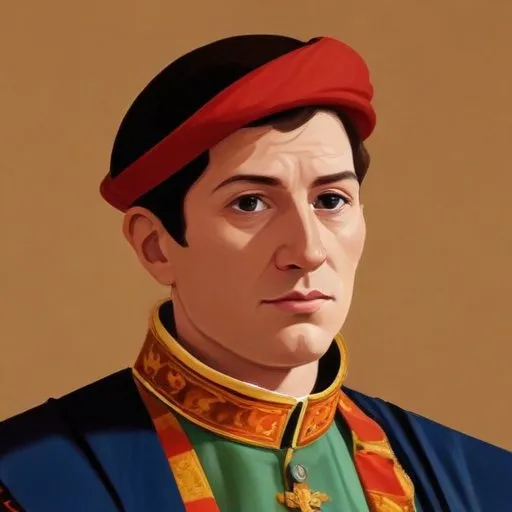
The second son of Cosimo I de' Medici, he was a Tuscan nobleman and a prominent figure in the Medici family, known for his involvement in the family's politics and cultural patronage.
Garzia de Medici, the son of Cosimo I de Medici, Grand Duke of Tuscany, and Eleanor of Toledo, is best known for being the subject of a famous painting by Bronzino when he was just an infant. This artwork has become an iconic representation of the Medici family's power and influence during the Renaissance.
Born on July 5, 1547, in Florence, Garzia was destined for greatness. His parents had big plans for him, envisioning a military career that would bring honor to the Medici family. At the tender age of 13, he was named Honorary Commander and Supreme Commander of the Tuscan galleys, a title that spoke to his family's high expectations.
In 1562, Garzia accompanied his family to the Tuscan coast, where they were set to embark on a journey to Spain. However, fate had other plans. Malaria struck, claiming the lives of Garzia, his mother Eleanor, and his brother Cardinal Giovanni, within a span of just a few weeks. The sudden loss of multiple family members sparked whispers of foul play, but modern exhumations have confirmed that they died of natural causes.
A centuries-old myth has persisted, claiming that Garzia murdered his brother Giovanni following a dispute in 1562. According to this tale, Cosimo I, enraged by his son's actions, took matters into his own hands and killed Garzia with his sword. However, there is no truth to this story, and forensic evidence has repeatedly debunked this claim.
Garzia's short life may have been marked by tragedy, but his ancestry speaks to the rich history of the Medici family. Through his father, Cosimo I, he was a descendant of the powerful Medici dynasty, which had risen to prominence in Florence during the 15th century.
Despite his untimely death, Garzia de Medici remains an important figure in the annals of Medici history, serving as a poignant reminder of the fragility of life and the unpredictability of fate.
Garzia de Medici's story serves as a testament to the transience of life and the importance of cherishing every moment. Though his life was cut short, his legacy lives on, a reminder of the enduring power of the Medici family.
Born in 1389
Ruler of Florence who brought stability and prosperity to the city, patronizing artists and humanists, and establishing the Medici dynasty. He was a shrewd politician and banker who laid the groundwork for the Renaissance.
Born in 1519
The Italian-French queen who married into the French monarchy and wielded significant power behind the scenes, known for her cunning politics and lavish court festivities. She sponsored the arts and architecture, leaving a lasting legacy on French culture.
Born in 1504
Leader of the Catholic Church during the Counter-Reformation, he excommunicated Queen Elizabeth I and played a key role in the Council of Trent.
Born in 1511
A Renaissance master who painted frescoes, wrote the first art history book, and designed buildings, leaving a lasting legacy in the art world.
