


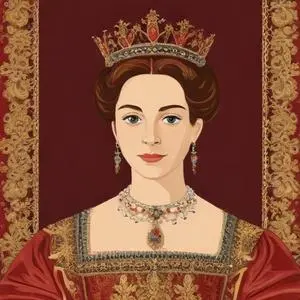
The Italian-French queen who married into the French monarchy and wielded significant power behind the scenes, known for her cunning politics and lavish court festivities. She sponsored the arts and architecture, leaving a lasting legacy on French culture.
Catherine de Medici, the 16th-century Italian noblewoman, is renowned for her formidable influence on French politics and monarchy during the tumultuous 16th century. As the wife of King Henry II and mother of three French kings - Francis II, Charles IX, and Henry III - Catherine's strategic prowess and shrewd diplomacy shaped the course of French history.
Born on April 13, 1519, in Florence, Italy, Catherine was the only child of Lorenzo de Medici, Duke of Urbino, and Madeleine de La Tour d'Auvergne. At the tender age of 14, she married Henry, the second son of King Francis I and Queen Claude of France, in 1533. This arranged marriage, orchestrated by her uncle Pope Clement VII, would ultimately catapult Catherine onto the French political stage.
Following her husband's accidental death in 1559, Catherine's son Francis II ascended to the throne, with Catherine assuming the role of regent. When Francis II died in 1560, Catherine became regent once more, this time for her 10-year-old son Charles IX. Her astute political acumen and ability to navigate treacherous court intrigue enabled her to wield significant power, making her the de facto ruler of France.
Catherine's three sons reigned during an era of relentless civil and religious wars in France, with the monarchy facing numerous challenges. Yet, Catherine ensured the monarchy's survival, albeit precariously, by adopting a policy of compromise and concession towards the rebelling Calvinist Protestants, the Huguenots.
Catherine's impact on French culture and society is multifaceted. She patronized the arts, commissioning numerous projects, including the construction of the magnificent Château de Chenonceau. Her interest in astrology, alchemy, and mysticism led to the establishment of the first astrological observatory in France.
Catherine's philosophical leanings centered around the concept of raison d'état, or statecraft, believing that the ends justified the means in maintaining power and stability. This pragmatism often led to accusations of Machiavellianism and ruthless politics.
Catherine's reputation has been marred by controversy, with some historians accusing her of orchestrating the St. Bartholomew's Day Massacre, a brutal slaughter of thousands of Huguenots in 1572. While her exact role remains disputed, her involvement in the bloody event has led to a tarnished legacy.
Catherine de Medici's unwavering grip on French politics during the 16th century cemented her position as one of the most influential women in French history. Her legacy, though complex and multifaceted, serves as a testament to her unyielding determination to maintain power and ensure the survival of the French monarchy.
In conclusion, Catherine de Medici's remarkable life and reign continue to fascinate historians and scholars alike, offering a captivating glimpse into the cutthroat world of 16th-century French politics and the extraordinary woman who dominated its center stage.
Born in 1519
King of France from 1547 to 1559, known for his cultural and artistic patronage, and his role in the Italian Wars.
Born in 1757
The last Bourbon king of France, ruling from 1824 to 1830, known for his ultra-royalist views and attempts to restore absolute monarchy, leading to the July Revolution.
Born in 1519
King of France from 1547 to 1559, known for his cultural and artistic patronage, and his role in the Italian Wars.
Born in 1542
The last Scottish monarch of the House of Stuart, she was a Catholic queen who faced Protestant rebellion and was eventually beheaded, sparking a centuries-long rivalry with England. She's known for her tumultuous reign and tragic fate.
Born in 1533
The Virgin Queen, a powerful and beloved monarch, ruled England during a golden age of culture, literature, and exploration, establishing the Church of England and defeating the Spanish Armada.
Born in 1504
Leader of the Catholic Church during the Counter-Reformation, he excommunicated Queen Elizabeth I and played a key role in the Council of Trent.
