


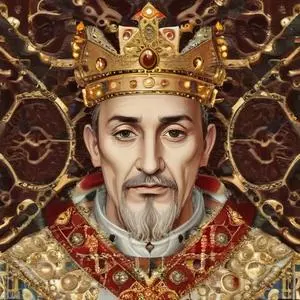
The Pope who sparked the English Reformation by refusing to annul King Henry VIII's marriage, leading to the creation of the Church of England. He's also known for his lavish spending and artistic patronage.
Clement VII, born Giulio de Medici, is famously known as the pope who struggled to maintain the Catholic Church's independence and unity amidst the tumultuous 16th century. His reign, marked by relentless political, military, and religious turmoil, left an indelible mark on Christianity and world politics.
Giulio de Medici was born on May 26, 1478, into the powerful Medici family in Florence, Italy. His cousin, Pope Leo X, recognized his exceptional statesmanship skills and appointed him as his chief advisor from 1513 to 1521. This role catapulted Giulio into the inner circle of papal politics, where he honed his diplomatic skills and forged crucial alliances.
In 1523, Giulio was elected pope, taking the name Clement VII. His reign was immediately beset by challenges: the Protestant Reformation was spreading, the Church teetered on the brink of bankruptcy, and foreign armies threatened Italy's sovereignty. Clement responded by attempting to unite Christendom, making peace among warring Christian leaders and liberate Italy from foreign occupation.
However, the complex political landscape of the 1520s thwarted his efforts. The Holy Roman Emperor Charles V and Francis I of France engaged in a protracted struggle for power, while the Turkish Empire, led by Suleiman the Magnificent, launched devastating invasions of Eastern Europe. Clement's problems were further complicated by his deteriorating relationship with Charles V, which eventually led to the brutal Sack of Rome in 1527. During this chaotic period, Clement was imprisoned in the Castel Sant'Angelo.
After escaping confinement, Clement was forced to compromise the Church's independence by allying with his former captor, Charles V. This decision sparked widespread criticism and earned him the reputation as the "most unfortunate of the popes." Despite his efforts to navigate the treacherous landscape of 16th-century politics, Clement's reign was marked by controversy and strife.
Clement VII's philosophical stance was deeply rooted in his commitment to Catholicism and the preservation of the Church's authority. He believed in the importance of maintaining the Church's independence and unity, even if it meant making difficult compromises with powerful secular leaders. His reign was marked by a struggle to balance the competing demands of Christian leaders, secular powers, and the Church's own interests.
Clement VII's legacy extends far beyond his tumultuous reign. His attempts to reform the Church and respond to the Protestant Reformation laid the groundwork for the Counter-Reformation. His compromise with Charles V also paved the way for the eventual rise of Catholic monarchies in Europe. Despite the controversies surrounding his papacy, Clement VII remains an important figure in the history of Christianity and the development of modern Europe.
"Unity is the pearl of great price, and the Church must preserve it at all costs."
Born in 1535
The second shortest-reigning pope in history, serving for just 27 days in 1605, he is most known for his brief but tumultuous papacy marked by power struggles and controversy.
Born in 1417
A 15th-century pope who played a significant role in the fall of the Western Schism, ending the division in the Catholic Church. He's also known for his lavish spending and nepotism.
Born in 1487
A 16th-century Pope who commissioned Michelangelo to paint the Sistine Chapel's frescoes and was a patron of the arts, leaving a lasting impact on Renaissance art and architecture.
Born in 1431
Ruthless and cunning, this Pope was infamous for his corrupt and immoral ways, using his power to further his family's interests.
Born in 1414
Established the Vatican Archives and commissioned the Sistine Chapel's ceiling, which was famously painted by Michelangelo. He also played a significant role in the Renaissance.
Born in 1431
Ruthless and cunning, this Pope was infamous for his corrupt and immoral ways, using his power to further his family's interests.
Born in 1568
The 17th-century Catholic leader who reigned for 21 years, known for his strong stance against Galileo Galilei and his scientific discoveries, as well as his extensive patronage of the arts.
Born in 1502
Introduced the Gregorian calendar, a solar-based calendar that's widely used today, reforming the Julian calendar's inaccuracies.
