


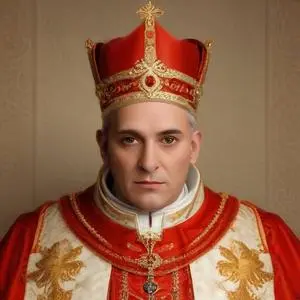
Ruthless and cunning, this Pope was infamous for his corrupt and immoral ways, using his power to further his family's interests.
Pope Alexander VI, born Rodrigo de Borja, is notorious for his scandalous personal life, nepotism, and Machiavellian politics, earning him a reputation as one of the most infamous popes in Catholic history. His papacy, which spanned from 1492 to 1503, was marked by a relentless pursuit of power, wealth, and influence, leaving an indelible mark on the Catholic Church and the Renaissance era.
Rodrigo de Borja was born on January 1, 1431, in Xàtiva, Kingdom of Valencia, to Jofr Llanol i Escriv and Isabel de Borja y Cavanilles. He studied law at the University of Bologna and was ordained as a deacon in 1456, following the election of his uncle as Pope Callixtus III. His rapid rise through the ranks of the Catholic Church was facilitated by his uncle's influence, and he became vice-chancellor of the Catholic Church in 1457.
Alexander's wealth and influence grew exponentially as he served under the next four popes, accumulating power and wealth through strategic alliances and shrewd political maneuvering. His election as pope in 1492 marked the pinnacle of his career, and he took the name Alexander VI, signaling a new era of Borgia dominance in Rome.
Alexander's papal bulls of 1493 confirmed Spanish claims in the New World, following Christopher Columbus's discoveries in 1492. However, his foreign policy was largely driven by a desire to secure the interests of his family, particularly his son Cesare Borgia, whom he supported as a condottiero for the French king during the Second Italian War.
Alexander's personal life was marred by scandals, including his acknowledgment of fathering several children with his mistresses. This led to his family name, Borgia, becoming synonymous with libertinism and nepotism, tarnishing his legacy and that of the Catholic Church.
Alexander's philosophical contributions were largely overshadowed by his political machinations and personal scandals. However, he was a proponent of humanism and supported the arts, commissioning works by prominent artists of the time.
Alexander VI's legacy is complex and multifaceted, marked by both controversy and cultural achievement. His papacy witnessed significant artistic and literary developments, including the construction of St. Peter's Basilica and the proliferation of Renaissance humanism. Nevertheless, his personal scandals and political machinations have left an indelible stain on his reputation, making him one of the most polarizing figures of the Renaissance.
| Year | Event |
|---|---|
| 1431 | Born in Xàtiva, Kingdom of Valencia |
| 1456 | Ordained as a deacon and made a cardinal |
| 1457 | Becomes vice-chancellor of the Catholic Church |
| 1492 | Elected as Pope Alexander VI |
| 1493 | Issues papal bulls confirming Spanish claims in the New World |
| 1503 | Dies in Rome, aged 72 |
Alexander VI's tumultuous papacy continues to fascinate and repel us, serving as a testament to the complexities of human nature and the corrupting influence of power. Despite his many controversies, his legacy remains an integral part of Catholic history, a poignant reminder of the triumphs and failures of the Renaissance era.
Born in 1487
A 16th-century Pope who commissioned Michelangelo to paint the Sistine Chapel's frescoes and was a patron of the arts, leaving a lasting impact on Renaissance art and architecture.
Born in 1475
A ruthless and cunning politician who rose to power in the Renaissance era through intrigue and military conquest, leaving a lasting legacy in politics and governance.
Born in 1480
The illegitimate child of a powerful pope, known for her ruthless politics, alleged poisonings, and scandalous marriages that shaped the Italian Renaissance.
Born in 1448
King of Naples from 1494 to 1495, known for his brief but tumultuous reign marked by wars and power struggles.
Born in 1380
Unified the Crown of Aragon, ruling over a vast territory in eastern Spain, and sponsored the voyages of Christopher Columbus, leading to the discovery of the New World.
Born in 1451
Unified the Spanish kingdoms, sponsored Christopher Columbus's voyage to the Americas, and established the Spanish Inquisition.
