


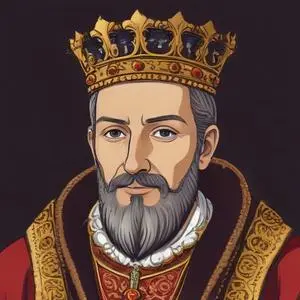
The first king of France to centralize power, establishing a strong monarchy and patronizing Renaissance art and culture. He's known for his military campaigns and cultural achievements.
Born on September 12, 1494, at the Château de Cognac in the Duchy of Aquitaine, Francis was the son of Charles, Count of Angoulême, and Louise of Savoy. After the death of his first cousin once removed and father-in-law, Louis XII, Francis succeeded to the throne, marking the beginning of a new era in French history.
Francis' reign was characterized by his exceptional patronage of the arts, which earned him the moniker "le Roi-Chevalier" (the Knight-King). He attracted numerous Italian artists, including Leonardo da Vinci, to work for him, fostering a cultural rebirth in France. The king's passion for art and architecture led to the construction of magnificent buildings, such as the Château de Chambord, which became a symbol of French Renaissance architecture.
Francis' promotion of humanism and the French language earned him the title "le Père et Restaurateur des Lettres." He encouraged the development of the French language, making it the official language of the court and promoting its use in literature and education. This marked a significant shift away from Latin, solidifying French as a prominent language in Europe.
During Francis' reign, France began to explore and colonize the New World. The king commissioned expeditions led by Jacques Cartier, who claimed lands in North America for France, paving the way for the expansion of the first French colonial empire.
Francis engaged in a series of wars with the Habsburgs, including the Italian Wars, and sought alliances with other European powers, such as England and the Ottoman Empire. The famous meeting at the Field of the Cloth of Gold, where Francis met with Henry VIII of England, was a notable attempt to form an alliance against the Habsburgs. Later, he formed a controversial alliance with the Muslim sultan Suleiman the Magnificent, a move that shocked Christian Europe.
Francis I of France left an enduring legacy as a patron of the arts, a promoter of humanism, and a shaper of the French language. His reign marked the beginning of a golden age in French history, and his influence extended beyond France, shaping European culture and politics for centuries to come.
Francis was known for his extravagant lifestyle, earning him the nickname "Le Grand Colas" (the Great Colas). He was a skilled athlete and a passionate hunter, often indulging in lavish feasts and tournaments. Despite his indulgent nature, Francis was also a devoted husband and father, marrying Claude of France and having several children with her.
Francis I's patronage of the arts, his promotion of the French language, and his role in shaping French culture have had a lasting impact on modern society. His legacy continues to inspire artistic and cultural endeavors, cementing his place as one of the most influential figures in French history.
Born in 1519
King of France from 1547 to 1559, known for his cultural and artistic patronage, and his role in the Italian Wars.
Born in 1519
The Italian-French queen who married into the French monarchy and wielded significant power behind the scenes, known for her cunning politics and lavish court festivities. She sponsored the arts and architecture, leaving a lasting legacy on French culture.
Born in 1542
The last Scottish monarch of the House of Stuart, she was a Catholic queen who faced Protestant rebellion and was eventually beheaded, sparking a centuries-long rivalry with England. She's known for her tumultuous reign and tragic fate.
Born in 1533
The Virgin Queen, a powerful and beloved monarch, ruled England during a golden age of culture, literature, and exploration, establishing the Church of England and defeating the Spanish Armada.
Born in 1519
King of France from 1547 to 1559, known for his cultural and artistic patronage, and his role in the Italian Wars.
Born in 1757
The last Bourbon king of France, ruling from 1824 to 1830, known for his ultra-royalist views and attempts to restore absolute monarchy, leading to the July Revolution.
