


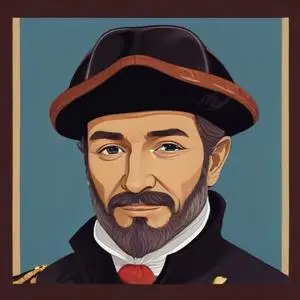
French navigator and explorer who led three expeditions to North America, mapping the Gulf of St. Lawrence and claiming the region for France. He's also credited with introducing Europeans to the concept of tobacco.
Jacques Cartier, a Breton-French maritime explorer, is renowned for being the first European to describe and map the Gulf of Saint Lawrence and the shores of the Saint Lawrence River, which he named "The Country of Canadas" after the Iroquoian names for the two big settlements he saw at Stadacona (Quebec City) and at Hochelaga (Montreal Island).
Born on December 31, 1491, in Saint-Malo, a port on the northeast coast of Brittany, Cartier's life was set to take a dramatic turn. In 1520, he married Mary Catherine des Granches, a member of a leading aristocratic family, which improved his social status considerably. His good name in Saint-Malo was recognized by his frequent appearance in baptismal registers as godfather or witness.
In 1534, Cartier was introduced to King Francis I by Jean Le Veneur, bishop of Saint-Malo and abbot of Mont Saint-Michel, at the Manoir de Brion. The King had previously invited, although not formally commissioned, the Florentine explorer Giovanni da Verrazzano to explore the eastern coast of North America on behalf of France in 1524. Le Veneur cited voyages to Newfoundland and Brazil as proof of Cartier's ability to lead ships to the discovery of new lands in the New World.
On April 20, 1534, Cartier set sail under a commission from the king, hoping to discover a western passage to the wealthy markets of Asia. In the words of the commission, he was to "discover certain islands and lands where it is said that a great quantity of gold and other precious things are to be found."
Cartier's voyage took him twenty days to cross the ocean. Starting on May 10 of that year, he explored:
Cartier's voyages opened up the Saint Lawrence River to European exploration and paved the way for French colonization of North America. He is credited with giving Canada its name and is considered the founder of New France. His written accounts of his voyages, published in the 1540s, served as inspiration for subsequent explorers and helped to fuel European interest in the New World.
Cartier's marriage to Mary Catherine des Granches in 1520 helped to improve his social status. His introduction to King Francis I in 1534 marked a turning point in his career, leading to his first voyage. His voyages to North America took place in 1534, 1535-1536, and 1541-1542.
Cartier's voyages were motivated by a desire to find a western passage to Asia and to spread Christianity to the indigenous peoples of North America. His written accounts of his voyages reveal a deep fascination with the natural world and a sense of wonder at the vast, uncharted territories he encountered.
Did you know that Cartier's third voyage was cut short due to conflicts with the Iroquois and a lack of supplies? Or that he was arrested in 1543 on suspicion of theft and imprisoned for several months?
Cartier's voyages marked the beginning of European exploration and colonization of North America, shaping the course of modern history. His legacy can be seen in the many place names, cities, and landmarks that bear his name, including Quebec City, Montreal Island, and the Cartier River.
"I think that I have not done anything wrong, except to have believed in the goodness of the King and of his servants." - Jacques Cartier
Cartier's words, uttered during his imprisonment in 1543, reflect his sense of loyalty to the French crown and his unyielding commitment to his exploratory endeavors.
Born in 1567
French explorer who mapped much of eastern North America, establishing trade and settlement in what is now Canada and the northeastern United States.
Born in 1911
A veteran character actor with a distinctive voice, he appeared in numerous films and TV shows, often playing authority figures or villains.
