


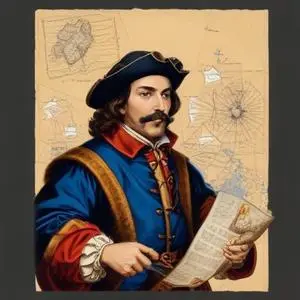
French explorer who mapped much of eastern North America, establishing trade and settlement in what is now Canada and the northeastern United States.
Samuel de Champlain, a French explorer, navigator, cartographer, and diplomat, is best known for founding Quebec City and New France in 1608, and creating the first accurate coastal map of North America during his numerous expeditions. This Renaissance man's contributions to the mapping and exploration of North America have left an indelible mark on the continent's history.
Born on August 13, 1567, in Brouage, France, Champlain was raised in a family of sailors, which laid the foundation for his future expeditions. His uncle, François Gravé Du Pont, played a significant role in shaping Champlain's early career, guiding him on his first trip across the Atlantic Ocean in 1603.
From 1604 to 1607, Champlain participated in the exploration and establishment of the first permanent European settlement north of Florida, Port Royal, in Acadia (present-day Nova Scotia). He then went on to found Quebec City in 1608, which became the cornerstone of French colonization in North America.
Champlain's cartographic skills led to the creation of the first accurate coastal map of North America, which was instrumental in guiding future explorers and settlers. His writings, particularly "Voyages et Découvertes faites en la Nouvelle France, depuis l'an 1615," published in 1619, provide valuable insights into the native cultures he encountered, including the Montagnais, Innu, Ottawa, and Wendat tribes.
Champlain formed long-lasting relationships with the native tribes, learning their languages and customs, and even agreeing to provide assistance in the Beaver Wars against the Iroquois. His understanding and respect for the native peoples earned him the nickname "Father of New France."
Samuel de Champlain's contributions to North American history are immeasurable. He played a crucial role in shaping the continent's geography, politics, and culture. His legacy extends beyond his expeditions, as he paved the way for future explorers, settlers, and traders.
Born in 1491
French navigator and explorer who led three expeditions to North America, mapping the Gulf of St. Lawrence and claiming the region for France. He's also credited with introducing Europeans to the concept of tobacco.
Born in 1626
The first Intendant of New France was a key figure in establishing and governing the French colony, overseeing its economic development, and implementing policies to ensure its growth and prosperity. They played a crucial role in shaping the colony's early years.
