


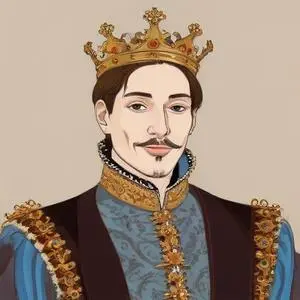
The monarch who approved the St. Bartholomew's Day massacre, a brutal slaughter of French Protestants, and was a puppet king controlled by his powerful mother, Catherine de' Medici.
Charles IX, the King of France from 1560 to 1574, is infamously known for his role in the St. Bartholomew's Day Massacre, a bloody event that marked the culmination of decades of tension between Protestants and Catholics in France. His reign was marred by religious civil wars, political strife, and a desperate attempt to reconcile his people, leaving a lasting impact on French history.
Born on June 27, 1550, Charles IX ascended to the throne at the tender age of 10, following the death of his brother Francis II. His mother, Catherine de Medici, played a significant role in shaping his policies, often guiding his decisions with an iron fist. Charles' reign was marked by a series of failed attempts to broker peace between the warring factions of Protestants and Catholics, ultimately leading to the outbreak of civil war.
In 1572, Charles orchestrated the marriage of his sister Margaret to Henry of Navarre, a prominent Protestant nobleman, in a bid to reconcile the religious divides. However, this effort was short-lived, as Charles, under the influence of his mother, authorized the massacre of numerous Huguenot leaders who had gathered in Paris for the royal wedding. The St. Bartholomew's Day Massacre, as it came to be known, resulted in the deaths of thousands of Protestants, dealing a devastating blow to the Huguenot movement.
Charles' decision to condone the massacre haunted him for the rest of his life, reportedly causing his physical and mental health to deteriorate rapidly. His reign was marked by continued violence, with the persecution of Huguenots and the siege of La Rochelle, a Protestant stronghold. Charles died of tuberculosis in 1574, without a legitimate male heir, paving the way for his brother Henry III to succeed him.
Charles IX's reign was marked by a strong Catholic influence, with his mother Catherine de Medici playing a significant role in shaping his policies. While Charles initially supported a policy of relative religious tolerance, he eventually succumbed to the pressures of his mother and the Catholic Church, leading to the persecution of Huguenots.
Charles IX's reign and the St. Bartholomew's Day Massacre had a profound impact on French history, shaping the country's religious and political landscape for centuries to come. The massacre also had far-reaching consequences for the Protestant Reformation, leading to the emergence of a more radical Protestant movement.
Charles IX's reign was marked by a complex web of religious, political, and personal struggles, which ultimately led to his downfall. His legacy is forever tied to the St. Bartholomew's Day Massacre, a brutal event that continues to haunt the collective conscience of France.
Charles IX was known for his delicate health and was often referred to as the "Sickly King." Despite his frailty, he was an avid hunter and enjoyed the outdoors. Charles' reign was also marked by a series of lavish festivals and tournaments, which showcased the opulence and extravagance of the French monarchy.
In conclusion, Charles IX's tumultuous reign and his role in the St. Bartholomew's Day Massacre continue to fascinate and horrify historians and scholars alike. His legacy serves as a poignant reminder of the devastating consequences of religious intolerance and the importance of promoting peace and understanding in the face of diversity.
44 Years Old
A Cameroonian professional footballer who played as a midfielder and won several titles with clubs in Europe and Africa. He's known for his skillful playing style and goal-scoring ability.
Born in 1691
A German nobleman who ruled Hesse-Darmstadt from 1739 to 1768, known for his military campaigns and territorial expansions.
Born in 1585
A powerful and cunning statesman who dominated French politics during the 17th century, known for his ruthless suppression of dissent and centralization of power. He was a master strategist and diplomat who shaped the course of European history.
Born in 1755
The last queen of France before the French Revolution, known for her extravagance and mismanagement of the French economy, which contributed to the downfall of the monarchy.
Born in 1462
The king who ruled France from 1498 to 1515, known for his military campaigns in Italy and his role in the Italian Wars, which shaped the country's foreign policy.
Born in 1438
Ruler of Savoy from 1496 to 1497, known for his brief but tumultuous reign marked by conflicts with neighboring states and internal power struggles.
