


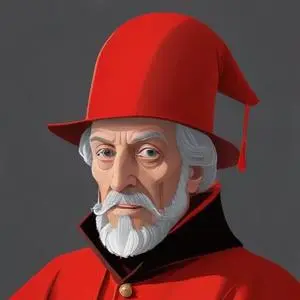
A powerful and cunning statesman who dominated French politics during the 17th century, known for his ruthless suppression of dissent and centralization of power. He was a master strategist and diplomat who shaped the course of European history.
Consecrated as a bishop in 1607, Richelieu's meteoric rise to power began when he was appointed Foreign Secretary in 1616. He continued to climb the ranks, becoming a cardinal in 1622 and chief minister to King Louis XIII in 1624, a position he held until his death in 1642.
Richelieu's primary objective was to consolidate royal power and limit the influence of the nobility. He believed that a strong, centralized state was the key to France's prosperity and security. To achieve this, he implemented a series of reforms, including the creation of a powerful centralized administration and the suppression of Huguenot rebellions.
In foreign policy, Richelieu's primary goal was to check the power of the Habsburg dynasty, reigning in Spain and Austria, and ensure French dominance in the Thirty Years War. He formed alliances with Protestant states, such as the Kingdom of England and the Dutch Republic, to achieve his objectives.
Richelieu was a passionate advocate for the arts and culture. As an alumnus of the University of Paris and headmaster of the College of Sorbonne, he renovated and extended the institution. He also founded the Académie Française, the learned society responsible for matters pertaining to the French language.
Richelieu's life was marked by several significant events, including his consecration as a bishop in 1607, his appointment as Foreign Secretary in 1616, and his elevation to cardinal in 1622. He also played a crucial role in the Day of the Dupes in 1630, which showcased his power and influence.
Richelieu's legacy continues to shape modern society. He is remembered as a visionary who transformed France into a strong, centralized state. His patronage of the arts and culture helped establish France as a hub of intellectual and artistic excellence. Today, he remains an iconic figure in French history, revered for his cunning, ambition, and unwavering commitment to his country.
Richelieu's contemporaries, including King Louis XIII and Cardinal Mazarin, recognized his genius and admired his unwavering dedication to France. While they may have differed in their approaches, they shared a common commitment to the country's prosperity and security.
Richelieu lived during a time of great turmoil and upheaval in Europe. The Thirty Years War was raging, and France was struggling to assert its dominance. Against this backdrop, Richelieu's rise to power and his subsequent reforms had a profound impact on French history.
| Year | Event |
|---|---|
| 1585 | Armand Jean du Plessis, 1st Duke of Richelieu, is born |
| 1607 | Consecrated as a bishop |
| 1616 | Appointed Foreign Secretary |
| 1622 | Becomes a cardinal |
| 1624 | Becomes chief minister to King Louis XIII |
| 1630 | The Day of the Dupes |
| 1642 | Death of Cardinal Richelieu |
Richelieu's life and legacy continue to fascinate and inspire. His unwavering commitment to France, his cunning, and his vision for a strong, centralized state have left an indelible mark on French history.
Born in 1606
A 17th-century French mastermind behind iconic plays like "Le Cid" and "Horace", known for pioneering the classical French tragedy genre.
Born in 1622
A 17th-century master of comedy, he penned witty plays that satirized the French aristocracy, leaving a lasting impact on Western theater. His works remain widely performed and adapted today.
Born in 1694
A witty and insightful 18th-century writer and philosopher who used satire to critique societal norms and advocate for reason, tolerance, and human rights.
