


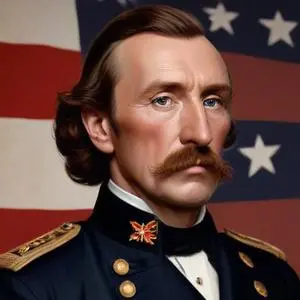
Led a cavalry regiment in the American Civil War and Indian Wars, ultimately meeting defeat at the Battle of Little Bighorn. He's infamous for his last stand against the Lakota, Cheyenne, and Arapaho tribes.
George Armstrong Custer is etched in American history as the dashing cavalry commander who led his troops to a heroic but doomed stand against a coalition of Native American tribes at the Battle of Little Bighorn. This pivotal event in 1876 marked the end of his life, but it also cemented his legend as a brave and daring military leader.
Born on December 5, 1839, in New Rumley, Ohio, Custer grew up in a family of modest means. Despite his humble beginnings, he was accepted into the United States Military Academy at West Point, where he graduated in 1861, 34th out of a class of 108 cadets.
Custer's military career took off during the American Civil War, where he worked closely with prominent generals like George B. McClellan and Alfred Pleasonton. His bravery and tactical prowess earned him rapid promotions, and by the age of 23, he was a brigadier general of volunteers.
In 1863, Custer fought at the Battle of Gettysburg, where he commanded the Michigan Brigade and secured a crucial victory against J.E.B. Stuart's forces. This triumph propelled him to national attention and solidified his reputation as a daring cavalry commander.
After the Civil War, Custer was commissioned as a lieutenant colonel in the Regular Army and dispatched to the Western frontier to participate in the Indian Wars. He was tasked with subduing the Lakota and other Plains Peoples, who were resisting the encroachment of American settlers on their lands.
Custer's military campaigns in the West were marked by controversy and brutality. He was known for his aggressive tactics, which often led to bloody conflicts with Native American tribes. Despite these criticisms, he remained a celebrated figure in American society, with many viewing him as a heroic frontiersman.
On June 25, 1876, Custer led the 7th Cavalry Regiment into the Battle of Little Bighorn, a catastrophic conflict that would claim his life and those of his men. Despite being vastly outnumbered, Custer's troops fought valiantly, but they were ultimately overwhelmed by the combined forces of the Lakota, Cheyenne, and Arapaho tribes.
The annihilation of Custer's command was a national sensation, and it sparked widespread outrage and mourning across America. His widow, Elizabeth Bacon "Libbie" Custer, would go on to crusade for her husband's legacy, portraying him as a martyr and a heroic figure in American history.
George Armstrong Custer's life and legacy remain shrouded in controversy. While he is remembered as a brave and daring military leader, his actions during the Indian Wars have been widely criticized for their brutality and disregard for Native American lives.
Today, Custer's legend continues to inspire debate and discussion. Some view him as a symbol of American courage and determination, while others see him as a symbol of imperialism and racism. Regardless, his place in American history is secure, and his flamboyant personality and daring exploits continue to captivate audiences to this day.
George Armstrong Custer's legacy extends beyond the realm of military history. He has been the subject of numerous books, films, and art works, cementing his place in American popular culture.
His flamboyant personality and daring exploits have inspired generations of Americans, and he remains one of the most recognizable figures in American history.
Born in 1848
Younger brother of George Armstrong Custer, he fought alongside him in the American Civil War and the Great Sioux War, meeting a tragic end at Little Bighorn. He's remembered for his bravery and loyalty to his brother.
Born in 1845
American lieutenant who led the 7th Cavalry Regiment at the Battle of Little Bighorn, where he was killed, becoming a symbol of the American West's violent expansion.
Born in 1840
An Irish-American colonel who fought in the American Civil War and later died at the Battle of Little Bighorn, known for his bravery and tactical skills. He's often remembered as one of Custer's most trusted officers.
