


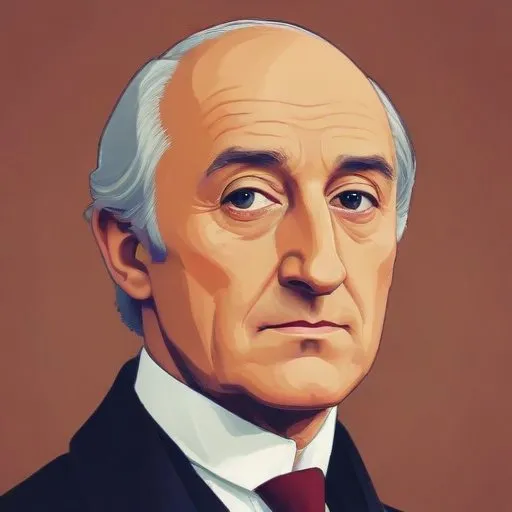
A skilled lawyer and politician who served as Prime Minister of the United Kingdom, known for his strong oratory skills and brief but influential tenure in office.
Known for his exceptional diplomatic skills and leadership, George Canning was a prominent British Tory statesman who played a crucial role in shaping the country's foreign policy during the early 19th century. As Foreign Secretary, he skillfully navigated the complexities of international relations, securing several diplomatic coups that cemented Britain's position as a dominant world power.
Born on April 11, 1770, to an actress and a failed businessman and lawyer, Canning's early life was marked by financial struggles. However, his uncle, Stratford Canning, provided him with financial support, enabling him to attend Eton College and Christ Church, Oxford, where he honed his intellectual and oratory skills.
Canning entered politics in 1793 and rapidly rose through the ranks, holding various senior cabinet positions under multiple prime ministers. He served as Paymaster of the Forces (1800-1801) and Treasurer of the Navy (1804-1806) under William Pitt the Younger, demonstrating his administrative acumen and earning the respect of his peers.
Canning's most notable achievements came during his tenure as Foreign Secretary (1807-1809 and 1822-1827) and Leader of the House of Commons. He masterminded the Battle of Copenhagen, securing Britain's naval supremacy over Napoleon, and later championed the American Monroe Doctrine, ensuring a major trading advantage for British merchants.
Canning's personal life was marked by controversy, including a notorious duel with his rival Lord Castlereagh in 1809. He was also known for his tumultuous relationship with King George IV, who frequently sought to undermine his foreign policies.
Despite his untimely death on August 8, 1827, Canning's legacy as a master diplomat and statesman endures. His diplomatic coups and leadership played a significant role in shaping Britain's foreign policy, earning him a place among the most influential figures of the 19th century.
"I defy the right honourable gentleman to produce an instance of a government, in a situation similar to ours, that has been more bold, more active, and more successful." - George Canning
George Canning's life and achievements are a testament to his exceptional diplomatic skills, leadership, and vision. His contributions to British history continue to inspire and educate, serving as a reminder of the importance of effective diplomacy in international relations.
Born in 1759
Prime Minister of the United Kingdom from 1783 to 1801 and 1804 to 1806, known for leading the country through the French Revolutionary and Napoleonic Wars.
Born in 1769
A French military leader who rose to prominence during the French Revolution and became Emperor of France, known for his military conquests and reorganization of Europe. He is also famous for his Napoleonic Code, which remains a foundation of modern law.
Born in 1762
The only British Prime Minister to be assassinated, he served from 1809 to 1812 and is known for his strong leadership during the Napoleonic Wars.
Born in 1738
The British monarch who ruled during the American Revolution, losing the colonies, and later suffered a mental illness that led to a regency crisis. He's also known for his cultural and artistic patronage.
Born in 1749
A prominent 18th-century politician who championed individual liberties and opposed British imperialism, known for his charismatic oratory skills and influential foreign policy decisions.
