


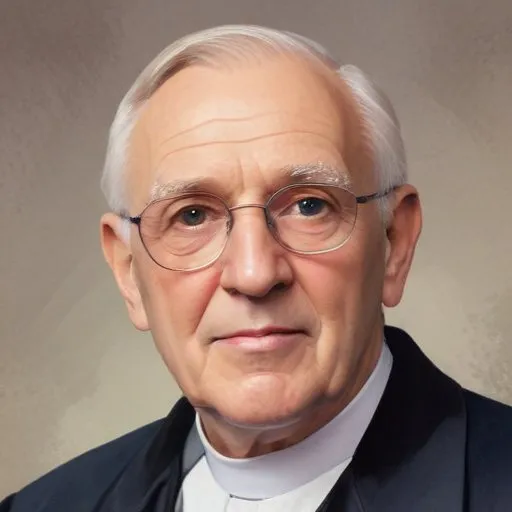
A priest who merged faith and science, exploring the universe and its mysteries, and advocating for a harmonious relationship between religion and astronomy.
George Vincent Coyne, a renowned American Jesuit priest and astronomer, dedicated his life to reconciling theology and science. As the director of the Vatican Observatory and head of its research group at the University of Arizona, Coyne played a crucial role in advancing our understanding of the universe while promoting a nuanced understanding of scripture.
Born on January 19, 1933, in Baltimore, Maryland, Coyne was the third of eight siblings. He attended Loyola High School in Blakefield, Maryland, on scholarship and graduated in 1951. Coyne then entered the Jesuit novitiate in Wernersville, Pennsylvania, where he began his spiritual journey.
Coyne's academic pursuits took him to Fordham University, where he earned his bachelor's degree in mathematics and licentiate in philosophy in 1958. He then pursued his doctoral studies in astronomy at Georgetown University, completing his Ph.D. in 1962 with a spectrophotometric study of the lunar surface.
Coyne's career was marked by a commitment to bridging the gap between theology and science. He was adamant that scripture was not a scientific textbook, stating, "Scripture is made up of myth, of poetry, of history. But it is simply not teaching science." This stance earned him recognition as a champion of interdisciplinary dialogue.
As director of the Vatican Observatory, Coyne oversaw a team of researchers dedicated to advancing our understanding of the universe. He was a visiting assistant professor at the University of Arizona's Lunar and Planetary Laboratory (UA LPL) and later became a senior research fellow at the LPL.
Coyne's research focused on the lunar surface, and he published numerous papers on the subject. His work also explored the intersection of theology and science, advocating for a nuanced understanding of scripture in the context of scientific discovery.
In addition to his research, Coyne taught at Le Moyne College in Syracuse, New York, from 2012 until his passing in 2020. He was a respected educator and mentor, inspiring countless students to pursue careers in science and theology.
Coyne received numerous awards for his contributions to science and theology. He was a fellow of the American Association for the Advancement of Science and a member of the International Astronomical Union.
George Coyne's legacy extends far beyond his scientific contributions. He showed that faith and reason are not mutually exclusive, but rather complementary aspects of human understanding. His commitment to interdisciplinary dialogue continues to inspire new generations of scholars and researchers.
In the words of Coyne himself, "The Bible is not a scientific textbook. But it is a profoundly human book, and its insights into human nature and human morality are as relevant today as they were 2,000 years ago."
Coyne was ordained as a Jesuit priest in 1966. He once said, "I don't think science and theology are mutually exclusive. I think they're complementary."
Throughout his life, Coyne remained committed to his faith and his scientific pursuits, leaving behind a legacy that continues to inspire and educate.
Coyne's work has had a profound impact on modern society, promoting a greater understanding of the relationship between science and theology. His legacy continues to influence scholars, researchers, and educators, ensuring that the dialogue between faith and reason remains vibrant and relevant.
91 Years Old
A renowned space expert who explored the universe, searching for life beyond Earth and explaining complex science in simple terms.
84 Years Old
A brilliant mind who unraveled the mysteries of black holes and the universe, making complex physics accessible to all through bestselling books.
68 Years Old
Astrophysicist and science communicator who makes complex concepts accessible to the masses through engaging writing and hosting popular TV shows. He's a leading voice in promoting science education and critical thinking.
Born in 1920
Leader of the Catholic Church from 1978 to 2005, known for helping to end communism in Poland and being a charismatic advocate for human rights and social justice.
99 Years Old
The first pope to resign in nearly 600 years, he's known for his conservative views and efforts to strengthen the Catholic Church's traditional teachings. He's also a prolific writer and theologian.
Born in 1564
Pioneering astronomer, physicist, and mathematician who played a major role in the Scientific Revolution, making key discoveries that challenged Aristotelian views and laid the foundation for modern science.
Born in 1879
A brilliant physicist who developed the theory of relativity and is considered one of the most influential scientists of the 20th century, known for his groundbreaking work in physics and mathematics.
63 Years Old
Theoretical physicist and mathematician who has written extensively on string theory and its implications for our understanding of the universe, making complex concepts accessible to a broad audience.
