


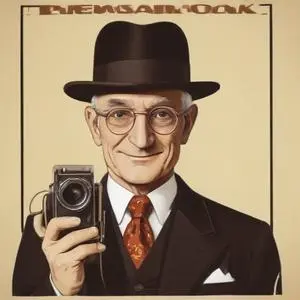
Founded the company that revolutionized photography by making it accessible and affordable to the masses through innovative film and camera technologies. Known for pioneering the development of roll film and the first point-and-shoot camera.
George Eastman is renowned for revolutionizing the world of photography by introducing the first roll film camera, making it accessible to the masses. As the founder of the Eastman Kodak Company, he played a pivotal role in transforming photography from a cumbersome and expensive process to a convenient and affordable hobby.
Born on July 12, 1854, in Waterville, New York, Eastman grew up on a 10-acre farm, where he received limited formal education. Despite this, he went on to become a bank clerk and eventually developed an interest in photography.
In the late 1870s, Eastman began experimenting with photography, driven by the desire to make it more convenient and accessible. After years of trials and tribulations, he patented the first roll film camera in 1884, which could capture multiple images without the need for reloading. This innovation marked the beginning of amateur photography.
Eastman was a prolific philanthropist, and his contributions to various fields are still felt today. He established the Eastman School of Music, Rochester Philharmonic Orchestra, and schools of dentistry and medicine at the University of Rochester. He also made significant donations to the Rochester Institute of Technology, Massachusetts Institute of Technology, Tuskegee University, and Hampton University, among others.
As the president of Kodak, Eastman oversaw the expansion of the company and the film industry as a whole. He introduced the concept of film development services, enabling users to send their rolls for processing, further democratizing photography. Under his leadership, Kodak became a household name, and photography became an integral part of everyday life.
Eastman's contributions to photography and philanthropy were recognized during his lifetime. He was awarded the Perkin Medal in 1913 for his innovations in applied chemistry, and the National Inventors Hall of Fame inducted him in 1977.
Eastman's personal life was marked by tragedy, including the loss of his mother at a young age and his own struggles with health issues. In his final years, he experienced intense pain due to a spinal disorder, which led him to take his own life on March 14, 1932, leaving behind a note that read, "To my friends: my work is done. Why wait?"
Today, Eastman is remembered as one of the most influential residents of Rochester, New York. His legacy is commemorated on several college campuses, and the George Eastman Museum has been designated a National Historic Landmark. He has also been immortalized on the Hollywood Walk of Fame.
Despite his remarkable accomplishments, Eastman's story is often overshadowed by his untimely demise. Nevertheless, his contributions to photography and philanthropy continue to inspire generations, ensuring his legacy as one of the most influential figures of the 20th century.
Born in 1847
A pioneer in innovation, credited with developing groundbreaking inventions that revolutionized the way people live and communicate, including the light bulb and phonograph.
Born in 1863
Founded the pioneering automobile manufacturing company that revolutionized the industry with the assembly line production method, making cars more affordable and accessible to the masses.
Born in 1839
Founded the Standard Oil Company, revolutionizing the oil industry and amassing vast wealth, which he later used for philanthropic efforts. He's remembered for his business acumen and generosity.
Born in 1835
A self-made industrialist who amassed a vast fortune in the steel industry, then donated most of it to fund over 2,500 public libraries and other philanthropic endeavors.
Born in 1837
Founded a powerful banking dynasty and dominated corporate finance, shaping the American economy through strategic investments and mergers.
Born in 1794
Built railroad empires, revolutionizing transportation and commerce, and donated extensively to education and the arts.
Born in 1819
Invented the first practical sewing machine, revolutionizing the textile industry and transforming the way clothing was made. This innovation had a profound impact on the Industrial Revolution and daily life.
Born in 1809
Co-founder of International Harvester, a pioneering manufacturer of agricultural machinery, revolutionizing farming with the mechanical reaper, increasing food production and transforming the industry.
