


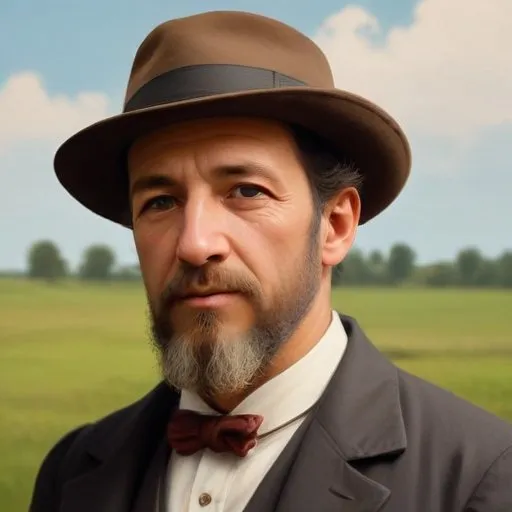
A pioneering landscape painter who explored the emotional and spiritual qualities of nature through his dreamy, soft-focus works, influencing the development of American art.
George Inness, an American landscape painter, is renowned for his unique and captivating works that bridge the gap between the physical and spiritual realms. His paintings, characterized by powerful, coordinated efforts to elicit depth of mood, atmosphere, and emotion, have earned him a place as one of the most influential American artists of the 19th century.
Born on May 1, 1825, in Newburgh, New York, Inness was the fifth of thirteen children to John William Inness, a farmer, and his wife, Clarissa Baldwin. His family moved to Newark, New Jersey when he was about five years old. In 1839, he studied for several months with an itinerant painter, John.
Inness's style underwent significant transformations throughout his prolific career, spanning over forty years and more than 1,000 paintings. Initially influenced by the Hudson River School, he later studied the Old Masters and the Barbizon school during his trips to Europe. This exposure led to his introduction to the theology of Emanuel Swedenborg, which had a profound impact on his artistic expression.
Inness's mature works, created between 1879 and 1894, exemplified the Tonalist movement and showcased his unique ability to capture the essence of a locale. By combining earthly and ethereal elements, he sought to demonstrate the reality of the unseen and connect the visible with the invisible. His use of light, color, and shadow created highly ordered and complex scenes that juxtaposed hazy and blurred elements with sharp and refined details.
Inness's artistic philosophy was deeply rooted in his spiritual beliefs. He believed that art should evoke emotions and convey the essence of a place, rather than simply representing its physical appearance. His legacy as the "father of American landscape painting" is a testament to his innovative and influential style, which continues to inspire artists and art lovers alike.
Inness received widespread critical acclaim during his lifetime, with art critics hailing him as one of America's greatest artists. His works were exhibited at the National Academy of Design, the Pennsylvania Academy of the Fine Arts, and the Brooklyn Art Association, among others.
Inness married twice, first to Delia Miller in 1849, with whom he had six children, and then to Elizabeth Abigail Hart in 1884. He died on August 3, 1894, at the age of 69, leaving behind a legacy that continues to inspire and captivate art enthusiasts.
Born in 1826
A prominent landscape painter of the Hudson River School, capturing the majesty of the American wilderness and exotic locales in meticulously detailed, large-scale works. His paintings often conveyed a sense of awe and wonder.
Born in 1830
A renowned landscape painter of the American West, capturing the majesty of mountains, forests, and rivers in breathtaking detail, inspiring a sense of wonder and awe.
Born in 1820
A prominent American landscape painter of the 19th century, capturing the beauty of the American wilderness and rural life in his works. His paintings often featured serene, idyllic scenes of the American countryside.
