


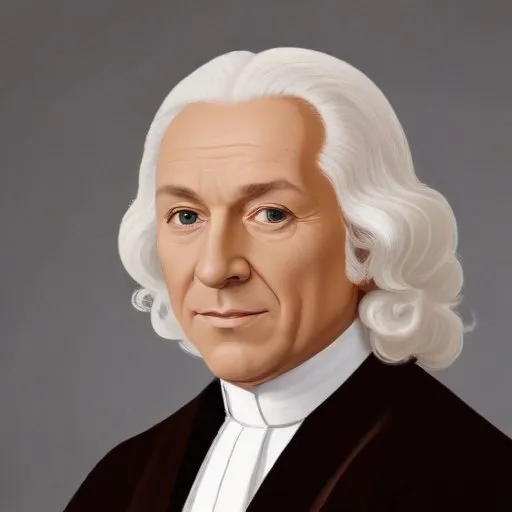
A 17th-century polymath who made significant contributions to astronomy, philosophy, and theology, and is most known for his mystical writings on the nature of God and the afterlife.
Emanuel Swedenborg, a Swedish Christian theologian, scientist, philosopher, and mystic, is best known for his book on the afterlife, Heaven and Hell (1758). This influential work cemented his reputation as a visionary and spiritual leader, shaping modern Christianity and inspiring the development of the New Church, also known as Swedenborgianism.
Born Emanuel Swedberg on January 29, 1688, in Stockholm, Sweden, Swedenborg came from a family of clergymen and scholars. He studied at the University of Uppsala, where he earned a degree in philosophy and theology in 1709. His intellectual curiosity and interests spanned a wide range of subjects, from mathematics and astronomy to chemistry and anatomy.
Before his spiritual awakening, Swedenborg had a prolific career as a scientist and inventor. He made significant contributions to the fields of metallurgy, mining, and engineering. His inventions included a machine for lifting ships, a method for purifying water, and a device for detecting the existence of metals in ore.
In 1741, at the age of 53, Swedenborg entered a spiritual phase, marked by vivid dreams and visions. This culminated in a spiritual awakening on Easter Weekend, April 6, 1744, when he received a revelation that Jesus Christ had appointed him to write The Heavenly Doctrine to reform Christianity.
Over the next 28 years, Swedenborg wrote 18 published theological works, including De Nova Hierosolyma et ejus doctrina coelesti (Concerning the New Jerusalem and its Heavenly Doctrine, 1758) and True Christian Religion (1771). These works expounded his vision of the spiritual realm, the nature of God, and the importance of spiritual growth.
The New Church, founded in 1787, is a Restorationist denomination of Christianity that reveres Swedenborg's writings as revelation. Swedenborgianism, as it is also known, emphasizes the importance of spiritual growth, the role of the individual in the salvation process, and the concept of the "Universal Human" – the idea that each individual has a unique role to play in the spiritual realm.
Swedenborg's influence extends far beyond the realm of Christianity. His ideas have inspired philosophers, writers, and artists, including Immanuel Kant, William Blake, and Ralph Waldo Emerson. His emphasis on the importance of spiritual growth and individual responsibility has shaped modern thought and continues to inspire contemporary spiritual seekers.
"Heaven and hell are within us, and the Lord's kingdom is within us, and we are in His kingdom, and His kingdom is in the world, and the world is in His kingdom."
"The Lord's kingdom is a kingdom of love, and the Lord's love is a love of saving, and His love is in every detail of His kingdom, and every detail of His kingdom is a manifestation of His love."
Through his remarkable life and works, Emanuel Swedenborg continues to inspire and guide those seeking spiritual growth and understanding, leaving a lasting legacy that transcends time and denominational boundaries.
Born in 1724
Developed influential philosophical frameworks, such as the Critique of Pure Reason, that shaped modern Western thought on ethics, morality, and human understanding.
Born in 1596
Developed influential philosophical and mathematical concepts, including the famous phrase "I think, therefore I am," and laid the foundation for modern Western philosophy.
Born in 1632
A 17th-century philosopher and scholar who developed a comprehensive philosophical system that emphasizes God, nature, and human freedom, influencing modern thought on ethics, politics, and religion.
Born in 1632
A 17th-century thinker who laid the groundwork for modern democracy, arguing that governments derive their power from the people and that individuals have inherent rights to life, liberty, and property.
Born in 1711
A Scottish Enlightenment thinker who developed influential ideas on morality, ethics, and human nature, and is considered one of the most important figures in the history of Western philosophy.
Born in 1712
A pioneering thinker who shaped modern democracy and education with his ideas on social contracts, general will, and the importance of early childhood education. His writings influenced the French Revolution and modern political thought.
Born in 1694
A witty and insightful 18th-century writer and philosopher who used satire to critique societal norms and advocate for reason, tolerance, and human rights.
61 Years Old
A lawyer and politician who served in the U.S. House of Representatives from 1987 to 1997, known for his moderate Republican views and advocacy for environmental issues.
