


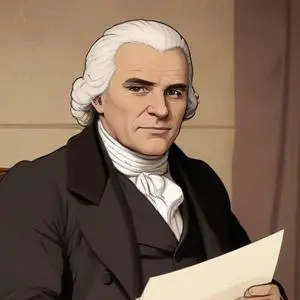
A leading figure of the French Revolution, instrumental in the overthrow of the monarchy and establishment of the First French Republic, known for his radical Jacobin ideology.
Georges Danton, a towering figure in the French Revolution, is best known for his impassioned oratory skills, his role in the fall of the monarchy, and his eventual presidency of the Committee of Public Safety. Through his unwavering dedication to the revolution, Danton left an indelible mark on French history, shaping the course of the country's future.
Born on October 26, 1759, in Arcis-sur-Aube, Champagne, France, Georges Danton was the son of Jacques Danton, a respectable lawyer, and Madeleine Camus. Despite a near-fatal encounter with a bull as a baby, Danton grew up to be a strong and ambitious individual. He pursued his education in Paris, earning a degree in law and eventually becoming a successful lawyer in his own right.
Danton's oratory skills and charisma soon propelled him to the forefront of the French Revolution. As a member of the Cordeliers Club, he became a prominent figure in the sans-culottes movement, advocating for the rights of the common people. His impassioned speeches and natural leadership abilities earned him a place in the National Convention, where he played a crucial role in the fall of the monarchy on August 10, 1792.
Following the fall of the monarchy, Danton was appointed Minister of Justice, a position that granted him significant influence over the direction of the revolution. However, his alleged involvement in the September Massacres and his support for the foundation of the Revolutionary Tribunal, which became notorious for its brutality, tarnished his reputation.
As the president of the Committee of Public Safety, Danton's moderate stance on the use of force came into conflict with the radical views of Maximilien Robespierre, leading to a rivalry that would ultimately seal his fate.
In early 1794, Danton's criticism of the Committee of Public Safety led to accusations of conspiracy and venality. He was arrested, put on trial, and ultimately executed by guillotine on April 5, 1794, at the age of 34.
Despite the controversies surrounding his life and death, Georges Danton's contribution to the French Revolution cannot be overstated. He played a pivotal role in shaping the course of the revolution, and his legacy continues to inspire and influence French politics to this day.
In the eyes of many historians, Danton remains the chief force behind the overthrow of the French monarchy and the establishment of the First French Republic. His unyielding commitment to the revolution, though sometimes marked by controversy, cements his place as one of the most significant figures in French history.
"We must dare, dare again, always dare!" - Georges Danton
This iconic quote, often attributed to Danton, encapsulates his unwavering spirit and commitment to the French Revolution.
Georges Danton's life and legacy are inextricably linked with the tumultuous period of the French Revolution. His rise to prominence, rivalries, and eventual downfall are all set against the backdrop of one of the most pivotal moments in modern history.
In the centuries that followed, Danton's reputation has been subject to various interpretations, with some historians portraying him as a heroic figure, while others view him as a ruthless opportunist. Nevertheless, his impact on French politics and history remains undisputed.
Born in 1758
Radical leader of the French Revolution, instrumental in the Reign of Terror, and advocate for the execution of King Louis XVI.
Born in 1755
A key figure in the French Revolution, leading the coup that overthrew Maximilien Robespierre and later serving as a key advisor to Napoleon Bonaparte. He played a crucial role in shaping French politics during a tumultuous period.
Born in 1767
Radical Jacobin leader during the French Revolution, known for his extreme views and role in the Reign of Terror.
Born in 1760
French journalist and politician who sparked the French Revolution with his impassioned speeches and writings, advocating for democracy and social reform.
Born in 1736
Astronomer and mathematician who calculated the orbit of Halley's Comet and later became a key figure in the French Revolution, serving as the first mayor of Paris. He played a crucial role in the early stages of the Revolution, helping to establish the National Assembly.
