


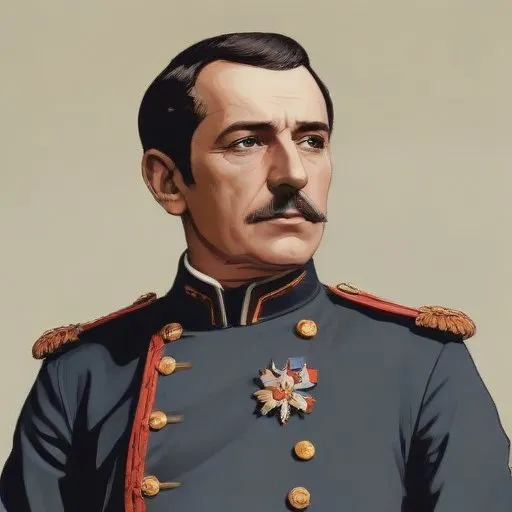
A French general and politician who served as Minister of War, known for his populist and nationalist ideology, which sparked a political crisis in the late 19th century. He's infamous for his attempted coup and subsequent exile.
Georges Ernest Boulanger, nicknamed "Général Revanche" or General Revenge, was a French general and politician who left an indelible mark on French history during the late 19th century. He is remembered for his unwavering passion for revanchism, a movement that sought revenge against Germany for France's defeat in the Franco-Prussian War, and his brief but intense rise to power in the late 1880s.
Born on April 29, 1837, in Rennes, France, Boulanger came from a family of modest means. He was drawn to the military at a young age and enrolled in the Ecole Spéciale Militaire de Saint-Cyr in 1856. During the Franco-Prussian War, he distinguished himself as a brave and capable officer, earning several decorations for his valor.
In the aftermath of the war, Boulanger became increasingly vocal about his desire for revenge against Germany. He believed that France needed to rebuild its military strength and assert its dominance over Europe. His passionate speeches and writings resonated with the French people, who were still reeling from the defeat. By the late 1880s, he had become a hero to the working-class districts of Paris and other cities, as well as to rural traditionalist Catholics and royalists.
In 1888, Boulanger won multiple elections, capitalizing on his popularity and the discontentment of the French people with the corrupt and ineffective government. His movement, known as the Boulangists, attracted supporters from both the left and the right, who saw him as a strong leader who could restore French pride and power.
At the height of his popularity in January 1889, Boulanger was feared by many to be powerful enough to establish himself as a dictator. However, changes in the electoral laws and the opposition of the established government, combined with Boulanger's self-imposed exile, contributed to a rapid decline of the movement.
The defeat of the Boulangists marked a turning point in French history, paving the way for the rise of the Opportunist Republicans. Although Boulanger's movement ultimately failed, he had a profound impact on French politics and culture. He introduced the concept of revanchism, which would continue to shape French foreign policy and contribute to the outbreak of World War I.
Despite his flaws and weaknesses, Boulanger remains a fascinating and complex figure in French history. His charisma, passion, and unwavering commitment to his ideals continue to inspire and intrigue historians and scholars to this day.
Boulanger's life and legacy are inextricably linked to the tumultuous period of French history following the Franco-Prussian War. His rise and fall serve as a testament to the complex and often contradictory nature of French politics during the late 19th century.
Today, Boulanger is remembered as a polarizing figure who embodied both the best and worst of French nationalism. His legacy continues to fascinate and educate historians, scholars, and the general public alike, offering a unique window into the complexities of French history and politics.
Born in 1838
A French lawyer and politician who served as Prime Minister of France, known for his key role in the Franco-Prussian War and his efforts to modernize and unify France. He's a significant figure in French history, shaping the country's politics and identity.
Born in 1816
A French general who led military campaigns during the Franco-Prussian War and later became a prominent figure in the Paris Commune. He's most known for his bravery and strategic military skills.
